Showing posts with label furniture. Show all posts

Nov 7, 2014

Early Edition 670 & 671, Part II

This post actually belongs to a series of updates dealing with a restoration of an early series 670 & 671, or better know as the Eames Lounge chair. The "series" might sound a bit of an overstatement as as the last related story was released almost one year ago...yes, point taken - we really need to shape up a bit! Anyhow, if you want to revisit the earlier parts you can find them here: 1 & 2.

So, back to the key character of the story - The Chair. After the initial assembly and first inspection (the chair had been disassembled for transportation) it was evident it needed to be disassembled again and work on the separate components should begin.

The frame

The first thing to do was to remove the cushions. It was easy to just unclip and slide them off the panels. Then off came the armrests, which are fixed in place with three screws in this early model. Later models have only two screws attaching the armrests to the metal brackets.


Early armrests with three screws

Next, the metal brackets on both sides of the chair fixing the backrest to the rest of the assembly were separated by removing four screws. When loosening the screws one should be very careful as the weight of the backrest starts quickly forcing the backrest down and if not supported properly, the wooden parts can easily break. Subsequently, the two backrest panels were separated from each other.


Armrest metal bracket

After the rosewood seat and backrest panels were taken apart from each other the die casted aluminum base was detached from the seat and ottoman panels. This was done by loosening four screws. 


Ottoman base

Once the chair was fully disassembled to individual components its dirtiness was even more evident. The entire structure was covered with years of dirt combined with a suspicious mix of old surface treatments. Additionally, the wood panels were very dry and desperately screaming for some oil.

Rosewood seat panel

Before the wood could be retreated with oil it was important to wash the panels throughly. A good approach is to use steel wool together with some sort of cleansing liquid. Pekka used a commercial cleansing liquid made specifically for furniture (there are several brands available to choose from). Alternatively, you could also choose to use methylated spirit or mineral spirits for cleaning. Whatever your preference, it is important first to try it on an area which is not visible to the eye, such as an area covered by a cushion. It is also good to do the cleaning in a well ventilated area or even outside as the evaporating fumes will make your head hurt if working in a closed, small space.


Seat panel - before

Pay attention when using steel wool on veneer. Rub it only to the direction of the grain, otherwise you might scratch the wood and leave unwanted marks. Be also careful when working on the areas where brand labels are located as you don't want to damage them either.

Use clean rags or household towels once you start rubbing the wood with cleansing liquid. As soon as the dirt starts coming off the panels do not smear it all over the panel, but rather wipe it off with a clean rag. Next, add more fresh cleansing liquid to the steel wool and repeat the same procedure to the rest of the panel.


Working with steel wool

After the panels are clean and dry it was time to start the most rewarding part of the restoration: applying the oil. Again, patience is a virtue: the oil can't be applied on a wet wood, ever. Depending on the ambient conditions and preferrer cleansing liquid with you may need to wait for a few hours or even to the next day just to be sure all the liquid have evaporated from the surface to be treated.


Panel-oil and a dachshund's snout

There are several types of oils to choose from. Some brand names indicate what the product actually contains (such as pure tung oil) and others are just names (such as tung oil finish) created by marketeers and might have little or nothing to do with the actual oil composition. The content of these products usually varies being usually a blend of some sort of oil, varnish and hardener, and perhaps not be the best choice for a vintage chair. Whichever oil you choose make sure you know how it will behaves on the surface to be treated, just to avoid any unpleasant surprises. Originally, Herman Miller used gun stock oil - so take a wild guess what Pekka chose for our chair?

Half washed, half oiled


After careful cleaning and treating, it is certainly a pleasure to see how the oil gives richness to the wood tones and really makes the grain pop. Yes, freshly oiled Rio palisander is indeed one of the prettiest sights we know!


Freshly oiled rosewood

In the next part of the series (promised, it will not take another year) we will show what happened to the base, domes of silence and the shock mounts. So please stay tuned!


Feb 16, 2013

The Cherner Chair

Remember the problem concerning the dining room chairs we addressed in the Round of Excuses posting? Briefly, after switching to a larger, elliptical table, we noticed there is no way to fit two DAWs between the table legs. Therefore, a global hunt for new chairs was initiated and finally we are delighted to report the most recent success of the HDP model!

The chair of the choice is the Cherner chair, by Norman Cherner for Plycraft (1958). Four (out of desired six) arrived to our home about a week ago from Florida. They are vintage (naturally), beautiful and fit nicely on the sides of the table. These chairs are made of plywood walnut veneer with a vinyl naugehyde upholstery. The search still continues, however, for two armrest versions of this same chair, which will be placed on each end of the table.

Cherner chair by Norman Cherner for Plycraft (1958) 

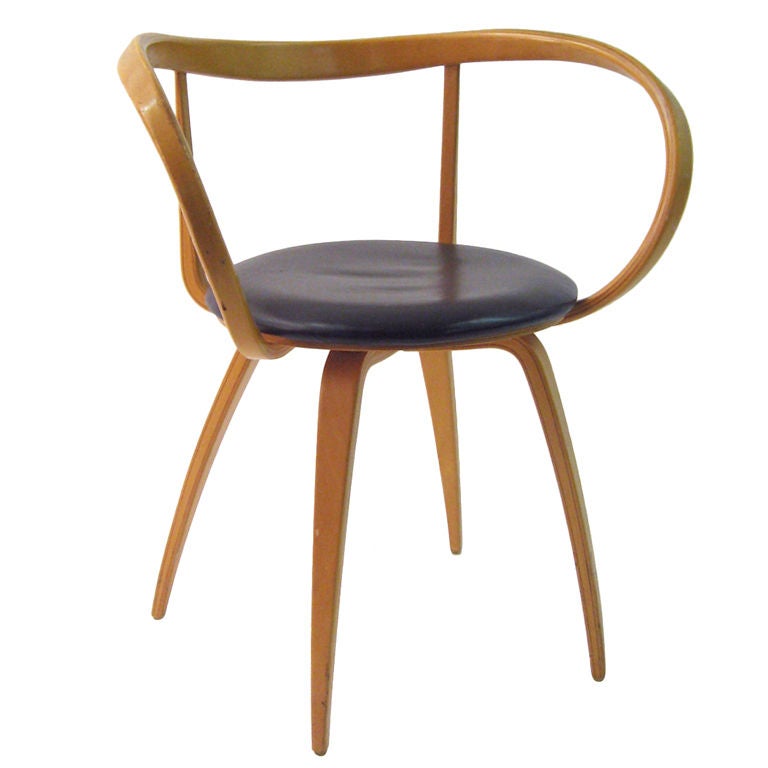
There is actually an interesting story behind the Cherner chair. In the 1950's, the Herman Miller company, led by George Nelson, wanted to create a lightweight chair out of plywood. However, the pretzel chair, designed by Nelson's office in 1952 and produced by another US company Plycraft located in Lawrence Massachusetts, was too fragile and costly, so the production was stopped in 1957.

At this point, Plycraft didn't want to waste the tooling, materials and techniques they had for constructing plywood furniture. Therefore, George Nelson recommended that Norman Cherner would design a sturdier and more economical Pretzel-like chair. Subsequently, Paul Goldman, the owner of Plycraft, hired Cherner. After turning in his design to Plycraft, however, Cherner was told the project had been stopped.

Curiously, a while later Cherner ran across his design in a furniture showroom in New York. Based on the label, he saw it was manufactured by Plycraft and designed by "Bernardo". As a result, Cherner sued Plycraft in 1961, won and received his royalties. Goldman also admitted that Bernardo was a fabricated name. Because of all this sometimes the design is mistakenly also attributed to either Paul Goldman or George Mulhauser. What a mess!!

Afterwards, Plycraft continued to produce Cherner's chair, but it was still difficult and expensive to produce. They continued to modify the original design over the years, leading to some visual variability among the vintage chairs. Ultimately, because of these difficulties the chair remained in production only until the 1970's. Cherner's sons have recently reissued their father's original designs with a company called Cherner Chair Company so a newer option exists for those who prefer new over vintage.


Label underneath our chairs indicate that they were produced after the law sued (1964)

So back to our fantastic four. After a long search we actually happened to find our chairs from Miami, USA, and they finally arrived about a week ago. Excited to see how they looked, felt and matched with the rest of the dining room, Pekka unwrapped and assembled the chairs right away.


Fresh from the Helsinki airport customs

Cherner chairs waiting to be assembled

And these four chairs are simply stunning! Someone has stated that these are the most beautiful pieces of furniture ever made out of plywood - and yes, we absolutely agree! What makes them stand out from their plywood rivals is the graduated thickness of plywood. This can be seen both on the legs and the seat. It is this structural feature that eventually enabled also the most important design cue of the Cherner chair: the narrow waist. The graduated thickness, together with the flowing shape of the armrest, were additional features making this chair difficult and expensive to manufacture. Considering all this, it is easy to see why this particular design is very difficult to copy. This is also the reason why there are so few knock-offs in the market, and if you happen to find one it would be fairly easy to distinguish a knock-off from an original.

Cherner beauty

And not only these four chairs are amazingly beautiful, they are also in exceptional condition! Manufactured in 1964 they are now nearly 50 years old and practically flawless. It is almost as if they landed to our home in a protective time capsule from a bygone era. It makes you wonder where they have spent the past 50 years - unused in some warm storage room, maybe?

Label from 1964

The foot pads, intact and like brand new. Yet, they are almost 50 years old!

At this point, we would like to present our sincerest regards to the person who sold us these beautiful chairs, Anna from Miami (dosbananos in eBay). This purchase was definitely one of the smoothest, fastest, and most reliable processes we have ever experienced. So please take note, if you are looking for a design item from the North American market. Please do not hesitate to contact her - we are glad to give her our highest recommendations!

And just to conclude - what did Urho think of all this? Honestly, he could not care less. After all, they are just chairs. Way too high for a sausage dog to enjoy them.

While you are working on those chairs, let me just rest my eyes for a minute...or two!

So the problem with the dining room chairs is now solved. Right? Well, not exactly. With the new chairs, the table no longer looks as nice as it once did...

Dec 29, 2012

Final frontier - completed

There is a little room upstairs which has been less spoken of until now. Referring to the floor plan, it is the farthest one of the two small rooms planned to be a combined study and a guest room. The cupboards in this room were already painted at the same time with the rest of the cupboards and floor sanded and lacquered in the very beginning of the renovation project. However, because we have had no urgent need for this room, the old and ugly wall paper has remained in place and it has effectively served as a storage for all the tools, paints and other renovation gear.

Starting point
While we were renovating - the gear graveyard

A few weekends ago the time came, when Pekka started the final battle with the study which was the last room needing work upstairs. After dumping all the renovation junk downstairs he removed the old wallpaper and painted the walls white. Now, after moving in we have noticed an interesting phenomenon: the threshold of starting any renovation related task seems to grow greater by the day, even if the to do list is still quite long. After finally finishing whatever a task in question happens to be, we always wonder how on earth it took so little time even if the time spend procrastinating with it was so enormous.

Rip me off

Anyhow, the study is now painted, furnished and ready for use, so few lines of the end result are in place. On the left wall, we have a vintage String unit with teak finish, which was found through eBay while still living in our previous apartment. When we moved here in September, the String shelf was first placed in the living room on the wall where we now have the Vodder credenza. It fits much better, however, to the study both from functionally and visually. It is quite a large system, and thus for the study we used only part of them leaving the rest of the pieces for other rooms.

The String shelf system is very well known also outside the collector community, but it's story might not be quite as familiar for the many String owners. It was created by Nisse and Kajsa Strinning in 1949 for a competition initiated by Bonnier public libraries. The goal of the competition was to create an assembly and expandable book case. The Strinnings' design won the competition and was exhibited in the H55 exhibition in Helsingborg in 1955, then becoming a huge sales success in 1960's. The shelf system consists of veneer shelfs hung on plastic coated wire ends, and it is still in production in many different colors and materials.

String shelf system and Nesso lamp

The study room also offers a home for three different lamps. The orange Nesso lamp in the picture above was designed by an Italian designer Giancarlo Mattioli for Artemide (1967). In the photo below is the PH Kontrast lamp, which is a base model of the current snowball pendant. The PH Kontrast was originally designed by Poul Henningsen for Louis Poulsen in 1958-1962 but due to the elaborate details, it cost too much to produce so it was discontinued in 1970's.

PH Kontrast and Sunburst by George Nelson

The chair next to the table is a Bellini chair designed by Mario and Claudio Bellini for Heller USA (1998). This chair was still in development at Atelier Bellini in Milan when Pekka started working there as a designer. We actually have two of them and they belong to the so called 0-series, which is the series following the prototypes in the product development process. Therefore one can see the marks of trial and error of injection molding, which are absent in chairs in later production series.

Bellini chair and PH80 by Poul Henningsen

In the far end of the study two items remain which in the long run do not belong there at all. The first one is a very unpractical and large sliding door, which used to separate the kitchen and the living room, but was removed while renovation. It is yet to be decided whether we are going to use it or not, but until then this massive and ancient door is going to roam from room to room, wherever it happens to bother us the least. The Bubble chair by Eero Aarnio (1968) is waiting for summer, as it will be then place on the upstairs atrium terrace.

The sliding door and a Bubble chair

Dec 25, 2012

Three C's and a floor lamp

In the living room, there are still few more details we'd like to share with you more closely. Thus in today's posting, we'd like to address the ceiling, a couch, a coffee table and a floor lamp.

First, the ceiling. It has actually been quite a controversial topic from the very beginning. It basically divides people in two categories: to those who insist it to be painted white, and those who prefer it unpainted. From the start, we have belonged to the latter category, and thus the ceiling remains unpainted, whereas the red brick walls were painted white. Together, the wooden ceiling and white brick walls create a very inviting, natural, and Scandinavian look.


The view from the front door

Most of our furniture and lights are vintage, more specifically from the 1950's. The couch, however, is new, as couches from 1950's are small in size and not very well acclaimed for their coziness. In addition, we wanted the couch to be visually light but still somehow match the 1950's style prominent in the apartment. Therefore, we turned our eye on the Italian maestro Piero Lissoni, known for great couch design over the years. 

The sofa in question, called Toot, is manufactured by Italian company Cassina (2009) and fullfills all our preset criteria. It is also a great platform for a bunch of Kilim pillows (another obsession from the past). Naturally, the pillow colors were chosen to round up the color palette of the home.


Long enough for a lengthy dog?

Next, in front of the Toot sofa is a coffee table from another maestro, Danish modernist Hans J. Wegner. The table in our living room is called AT10 and it is manufactured by Andreas Tuck (1955). It is made of solid teak and has an underlying shelf made with woven cane. Wegner is considered one of the most influential furniture designer of the 20th century, thus being a synonym for the mid century Danish design. Over the years, he has designed over 500 different chairs with many different wood types and styles. The carpet under the table is from Artek.


Solid teak top with a raised edge

Behind the Toot sofa is a curtain made of wooden sticks. This is something which was originally prepared for our previous place to separate the foyer and the living room. When we moved in, it was delighting to notice the wooden curtain fits perfectly on the big windows without any major modifications. The large windows are beautiful and give character to the apartment, but the downside becomes noticeable during the winter: although the apartment is generally quite warm, the windows tend to radiate cold when the temperature drops below the freezing point. 


Wooden curtain

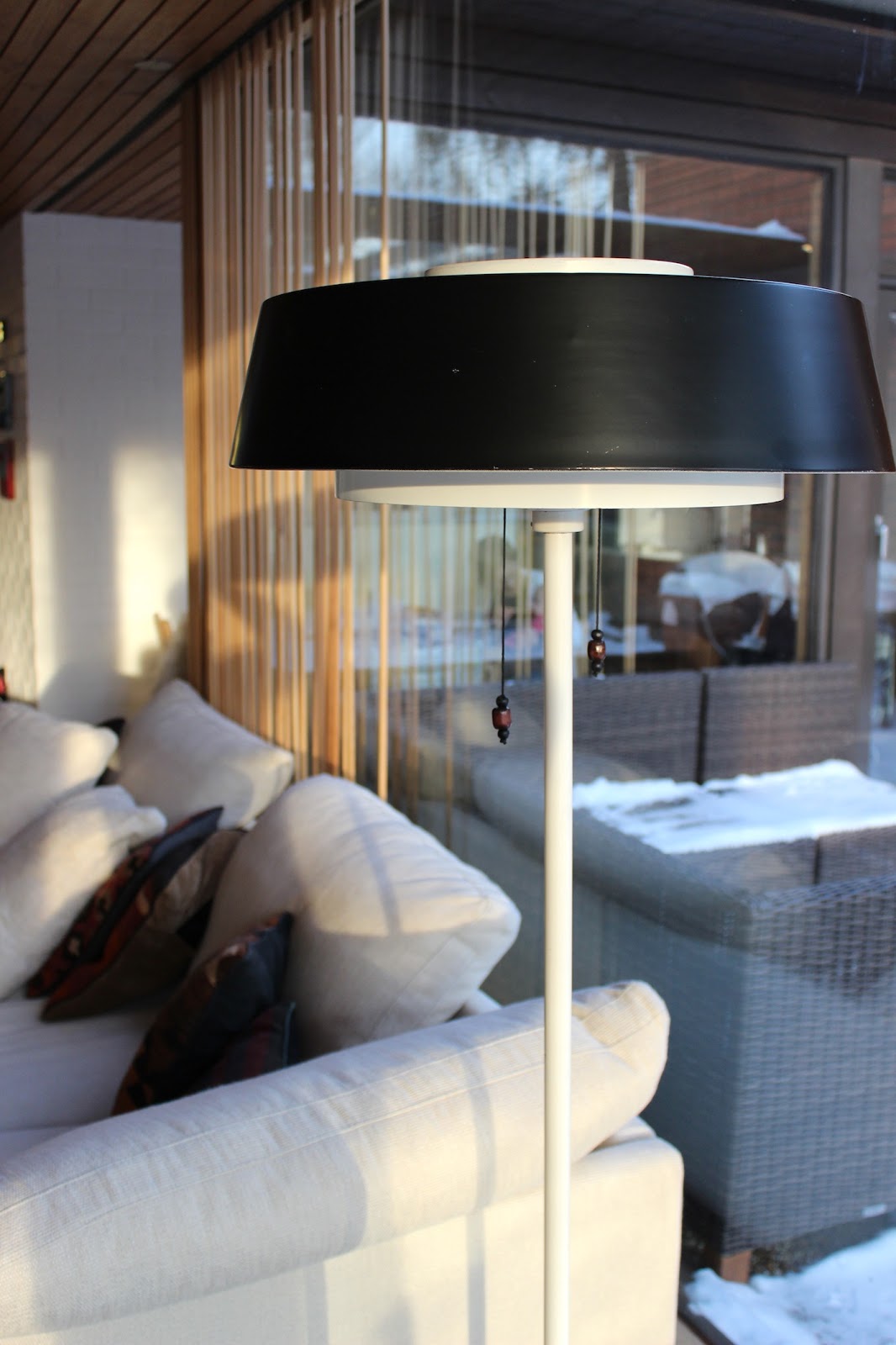
In the far end of the couch is Pekka's favorite piece of lighting, a floor lamp manufactured by company called Hiemstra Evolux from Amsterdam. The floor lamp is a real Dutch vintage design classic (1955), with a typical late fifties color scheme. It is not quite sure who is the original designer, but it is thought to be attributed to Leo Rutjens. The floor lamp provides both direct (downwards) and indirect (upwards) light. It is another one of those items which just all of a sudden appeared out of nowhere...


Hiemstra Evolux

And guess who loves the Toot sofa most of all? In Urho's opinion, the couch and the Kilim pillows are a perfect match to accommodate his needs, which basically revolve around relaxing, sleeping and just general procrastination. 


Don't mind modeling at all...

Dec 19, 2012

Arne Vodder

If you have been following this blog you are likely to be interested in mid century modern design. If so, you might have heard of Arne Vodder. If not, here is an opportunity to learn!

Arne Vodder was one of the most influential Scandicavian mid-century designers. He was first a student and then a business partner of the famous Finn Juhl (surely you have heard of him? If not - shame on you!), and is most appreciated for his beautiful sideboards designed in the 1950 - 1960's and manufactured by Sibast furniture.

In the history of design, a chair has often times been the center of attention, but in 1950's the focus drifted more towards sideboards, also known as credenzas. This is the period when many famous designers created their own version of this piece of furniture, and Vodder's creations are amongst the most well known and wanted ones. His designs are carefully detailed and free of sharp edges, and usually made of teak or rosewood.

And guess what? Our path just happened to collide with one of these! Being an active scout for antique, Pekka spotted one in a Finnish auction house, and naturally couldn't resist the temptation.

Vodder high board

Measuring 182 x 113 x 50 this credenza is considered a high board (vs. low board). The integrated drawer handles create a famous curved pattern known to Vodder's design.  It is made of rosewood, more particularly palisander. It was designed in the late 1950's and this particular piece was manufactured by Sibast furniture in 1966 (as stated in the sticker inside).

String of drawers
The famous curved handle
Manufacturer's label
Amazing quality of craftsmanship - a velvet lining for jewelry
No sharp edges

And what is the Vodder high board used in our home? Well, located next to the dinner table it offers an ideal storage space for glasses, wines and spirits. So if you can only get past the scary watch dog, you are more than welcome to come and enjoy a drink (or two) with us!

Guarding duties

Dec 3, 2012

Corner from the 1950's

Let's take a peak in the south end corner of the living room. There are three items to introduce, all made in 1950's. The first is a pair of Triennale teak easy chairs designed by Carl-Gustav Hiort af Ornäs. These chairs, made under licence by Gösta Westerberg Möbel AB Sweden, were launched at the Finnish pavillion at the 1957 Milano Triennale. Ours were found in a Finnish auction house, and at the time of purchase, we had no idea what they were, just liked how they looked. 

Two Triennales
Leather string armrests
Back view
The second item is an LTR (Low Table Rod) designed by Charles and Ray Eames and made by Herman Miller, originally introduced in 1950's. This small table is extremely versatile, as it can be moved around wherever needed, and even stacked (if you would happen own many of them) when its services are not needed. Currently in our home, it serves as a base table for a medium size ficus.

LTR
The third item is an AJ Floor Lamp designed by Arne Jacobsen and manufactured by Louis Poulsen. It was one of the many items designed for the SAS Royal Hotel in Copenhagen 1957. Like so many other things in our home, the AJ Floor Lamp was also purchased from a Danish auction house and it arrived while we were renovating our previous apartment a few years back.

AJ Floor Lamp
When it starts to get cold in the winter, during the day (and night) you tend to see less and less of Urho. He loves spending time in his own "basement", which is basically just a suspicious looking pile of four blankets. When he does come out, he expects to be feed, scratched and given treats. Oh, what a life!

Could I please now have my Dentastix?
Oh and we almost forgot! Thank you Pia for the very clear and useful instructions concerning the Latest Comments -gadget!

Oct 23, 2012

One sunny morning

An exceptional thing happened one morning. The sun was up. After countless rainy mornings, it felt somehow strange and refreshing. Immediately, we took the opportunity and shot some pictures of the living room, and wanted to share a few.  

Two Charles & Ray Eames designs: LCM (low chair metal) and the Lounge Chair
In the lounge end of the living room, there are a few different chairs designed by Charles & Ray Eames and made by Herman Miller. Near the window is the Eames Lounge Chair. This particular item is from the late 1960's, and it is made of Brazilian rosewood, the original wood used in these chairs. Interestingly, we also happen to have another one of these loungers. This one, from the early production series from 1956, just miraculously appeared to the Helsinki-Vantaa Airport customs from Chicago. Currently, it lays in the basement disassembled for restoration. Naturally, the whole restoration process will be shared with you in the future postings...

Genie in a bottle?
There are three artistic glass pieces on the Cadovius book shelf introduced earlier. These items, each about 50 cm tall, were found in a Finnish auction house some months ago. As you can imagine, they were painfully tricky to transfer home as well as to move over to the new apartment. Fortunately, they made it unharmed and in one piece.  We have absolutely no idea of their origin, but they were just too beautiful to pass by!

Can you spot Urho?
It is not our intention to block the beautiful big windows with the big white sideboard in the kitchen. Currently, it has two temporary functions before it will be moved. First, it provides a sunny place for our chilis to grow (thank you A&M) and second, it blocks Urho's access to our favorite lunch, noodles. The sideboard doors must remain closed at all times, otherwise when bored, Urho will take the opportunity and unpack a noodle bag or two...

Oct 6, 2012

Two (plus one) random shots

So far, we have posted quite a few pictures of the renovation project. Therefore, we thought it would be a refreshing change to introduce a few shots from one area which is already finished and currently being furnished, the living room.

A central piece of the living room is the Alanda coffee table by Paolo Piva for B&B Italia 1981. Pekka has been longing for this particular table for a while now, but being so large (120 x 120) there was no way we were able to squeeze it in to our old apartment. Besides, even if we find our tastes in terms of furniture is very similar in most cases, this table has never been on Minna's most wanted list. Miraculously one day, the table just appeared on our front door, as Pekka had hunted it down from ebay. It certainly stands out from the rest of our mid century furniture having an 1980's design language. However, as the living room has such large windows towards the atrium, in terms of the material the table matches the architecture of the apartment quite nicely.

Alanda coffee table

Another item in the living room is the Poul Cadovius Royal System. This wall unit made of plywood with teak finish is Danish design and dates back to 1955. We found it from a Swedish auction house and brought here into storage when we received the keys to the apartment. The modular system consists of several different shelves, drawers etc. but we only put some of them up for now. The assembly is still in process, as we just needed some shelf space to store some of the fragile items, so they wouldn't be harmed while moving in.

Cadovius Royal System
The progress made in all unfinished renovation projects has slowed down significantly, as Pekka needed to return to work, and Minna has two reasons slowing down her daily efforts. However, things are getting done slowly but surely. Also, Urho has come to discover some of the benefits of a bigger apartment and not having a proper kitchen. With an easy access to trash cans, when the opportunity arises he has been known to sneak and steal some lovely treasures. For instance, the other day we found an empty margarin box hidden behind the couch. Neither of us had never seen a box so clean, Urho had really done a through cleaning job!

"They made me lay here"