Showing posts with label lights. Show all posts

Sep 10, 2014

POP by Jaana Karell

Long before we had even found a new circular staircase (when the space still looked like a match box), the idea of the future wall decoration and related lighting already existed. As the back wall is quite spacious, we wanted the decoration to be something quite prominent, yet elegant and timeless, something which would again complement the original spirit of the apartment.

For once, the choice was not difficult. We both really love the look and feel of the POP panels designed by Jaana Karell (www.karelldesign.fi) and produced by a Finnish company Brainwood. These stunning wooden panels can already be found in several prominent locations such as Google and Microsoft in New York, Disney Studios in Hollywood, CNN in Atlanta, Federal Trade Commission and Hard Rock Café in Las Vegas. And finally, also now in our home!


POP panels by Jaana Karell

Jaana Karell is a Finnish designer who specializes in wood. She collaborates with various companies both as a consultant and by designing her own collections. Jaana and Pekka actually used to study in the same design school back in the 90's and thus go way back in time.

Since she was on a third grade, Jaana has been keen on carpentry. She loves using wood as a raw material in her designs, and the haptic aspect of wood is often strongly emphasized in her work. She finds that even if flat and clear surfaces are often preferred by designers, sometimes the essence of wood can be cleverly accentuated by the design of a given piece. For example, POP panels feel very soft to touch, so in addition to being visually appealing, the haptic experience is also very pleasant.


POP panels connecting the two floors

According to Jaana, in the development of POP panels the leading driver was to bring the designer's vision into reality. The original idea revolved around a timeless piece with a 70's feel, which she was keen on creating, even if the initial response from manufacturing companies was that it couldn't be done. "The bubbles edge is too sharp, the shape is not going to hold, the plywood will rip from the middle or that the ring shape around the bubble is not going to work" were some of the objections she faced. Therefore, she took action and made the molds for the prototypes herself to test the idea. Subsequently, one manufacturing company agreed to conduct a set of test presses if she would be able provide them the molds. So even if she was a student at the time, she paid the expensive molds from her own pocket and yes, the rest is history.


Box of teak panels

POP panels are commercially available in three different wood finishes: birch, cherry and walnut. Yet none of these materials, however, quite fit our home (we tend to be "teak people"). Also we are  constructing a teak slat wall downstairs, so the panel solution needed to meet these specific needs.

This is when the big idea of producing a custom panel set with teak was born. Again, we turned to the best source for veneer here in Finland: Janne Kuokkanen from Hollolan viilu ja laminaatti. Janne agreed to provide the suitable teak veneer for Brainwood, so they could produce the very first prototype set of teak panels. At this time, no one knew how well teak would settle in this particular form.

POP panels fresh out of the box

A bit of time passed, and after a seemingly long wait we received a shipment of thirty teak panels, both with curved and flat profiles. It is not an exaggeration to say it was love at first sight. With the teak veneer they had turned out perfect!

The panels arrived with an intelligent railing system made of extruded aluminum to be used as a wall fixture. According to Jaana the way the panels were to be fixed on a preferred surface played a critical part in developing process of the POP panels. The system needed to be invisible and seams in between the panels were designed to be as clean and unnoticeable as possible.

Aluminium profiles

Fixing the panels to the wall is very easy. Of course, it is important to start with a well leveled row of panels. Here again a laser proved indispensable to get the first aluminum profile perfectly horizontal. Once the profile is fixed, you simply place the panels on top of the rail. After this, you fix the next rail on top of the row of panels and keep repeating this until you reach the desired height.


First row up

Following the installation instructions, the system is really straightforward and fast to work with. The only real challenge for us was the height of the staircase (about six meters). It was a bit difficult to reach the upper rows, but with some previously practised ladder acrobatics Pekka succeeded to fix even the top row nicely in place.


Fully assembled set of panels

A charming curiosity absolutely worth of mentioning is the potential optical illusion of the POP panels. Sometimes a viewer might be a bit confused whether he or she is looking at a convex or a concave shape. In our set up, we wanted to light the panels from the side to enhance the 3D experience. For this, the adaptability of the Flos Parentesi lights proved to be quite ideal.

Pop & Parentesi - simply a perfect match

The POP panels are available in Finland via Brainwood and in USA via HighTower. Also, if you happen to be in Helsinki during the next five days, and are thinking of visiting the Habitare Furniture/Interior Decoration/Design Fair (10-14 September 2014), make sure to check out the POP panels at booth 7P67.

In their simplicity, the panels are really unbelievably beautiful. Needless to say, we just can't get enough of them.

Aug 16, 2014

Parentesi by Flos

A little while ago a few long waited packages finally arrived from Italy. For some time already, Pekka had been doing what he loves, in other words furiously hunting down vintage lights. More specifically, this time it was lights called Parentesi, and finally they were here!


Parentesi by Flos

The Parentesi light was designed by two italian designers Achille Castiglioni and Pio Manzu for the manufacturer Flos. After its launch in 1971 it had been accepted to the permanent collections of various museums around the world, including the MoMa in New York and the Triennale design museum in Milan. The light was also honored with the Compasso d'oro design award in 1979.


From below

The name of the light relates to the shape of its central component, a metallic tube resembling a parenthesis sign. The core concept of the light is very simple: a light source that can be moved up and down and turned 360 degrees in a steel wire, which is attached to the ceiling, extended straight down and held in its place by a weight. 

The light source

The simplicity of the Parentesi light is impressive. Not only because the product consists of only nine parts, but also due to the ingenuity of how the bulb assembly is held in position - only by the shape of the metallic tube.

The floor weight

With the nearly global ban of incandescent bulbs it is getting increasingly difficult to find the right kind of bulbs for these old lights. One might choose to use a more modern light source instead, even a LED, but it just wouldn't be the same than an old bulb. 


Bulbs sourced through eBay

When the Parentesi lights first arrived they were closely inspected. Then they had a warm bubble bath to rid the years of dust and dirt from all surfaces.


Some TLC

Even though there is now a Parentesi light in our dining room (the Coupé has moved downstairs) originally we wanted to have them for the staircase. Pekka's vision for this vertical space was that the lighting should somehow be in line with the proportions of the space and enhance the vertical experience. Also, we will be adding a wall decoration to one of the white walls, and the Parentesi arrangement with a steel wire holding up the two light sources is ideal for highlighting details.


Installation at 6 meters

In terms of installation, the challenge was that the space is more than 6 meters high. Therefore, some creativity was needed to develop a system to facilitate installation. An aluminum ladder, empty box of cereal, and the support from the handrail and opposite wall was all that Pekka needed to successfully solve the problem!


Dare to step on?

Very soon we noticed that switching on the two 150W incandescent bulbs at the same time creates not only a lot of light but also also a significant amount of heat. Fortunately, these type of bulbs are also available in 105W. Whereas the 150W bulb works perfectly in the dining room corner, for the staircase we might prefer a little less light. So the system needs to be modified one more time.

Lights on!

Now that the Parentesi lights have been installed to the corner of the staircase and are lighting up the wall we are ready to start with the wall decoration. We received the pieces a while a go and they have been just waiting for the installation of the lights. Very exciting - stay tuned!

An empty wall - not for long

Apr 14, 2014

Coupé by Joe Colombo

As we currently have "all in" for renovation, the process of acquiring vintage pieces for our home is temporarily on hold. That being said, postponing purchases is one thing, but letting such a mid century jewel as the Coupé light pass when bumping into a very reasonably priced specimen in an auction would be unforgivable. Simply put, this is the rationale why last weekend, a Coupé was allowed to move in.

The Coupé was designed by Joe Colombo, one of the brightest stars among the Italian mid century modernists, for Oluce in 1967. The light is part of the permanent collection at the MoMA in New York and in 1968, it won the "International Design Award" from the American Institute of Interior Designers in Chicago. The floor lamp (3321), just like its little sister, the table lamp (2202) provides direct light downwards and they both have adjustable, semi-cylindrical reflector in stove-enamelled aluminium. Similar to the reflector, the base also has identical finish whereas the stem is made of chromium-plated steel.

Coupé next to a rosewood credenza by Arne Vodder

Cesare "Joe" Colombo (1930-1971) devoted his short life for painting, sculpture and design. In the 1950's and 1960's, he belonged in an exclusive group of talented Italian designers who demonstrated to manufacturers how effective design could help them to better market products internationally. Achille Castiglioni, Gio Ponti, Ettore Sottsass, Mario Bellini and Joe Colombo were the central figures who with their work created a phenomena today known as "Italian design". The tragedy, of course, is the sad fact that Joe Colombo passed away as a result of a heart failure on his 41st birthday. One can not help but wonder what the world of design has missed due to this unfortunate loss.


Tilting reflector 

But back to the floor lamp. The general condition of the light is quite good. Given it is old it of course has some normal wear and tear typically found in vintage items. The base has some minor issues on the enameled finish and the reflector has a small bump. Considering, however, the action described in Kids, Dogs & Design it won't be the last hit this light is likely to receive.


Signs of life

Lets wrap the Coupé intro up with a very particular "behind-the-scenes" shot which would make Ivan Pavlov proud. Urho's behaviour during the photo shoots has been discussed before, but as it now seems to be approaching a standard-operational-procedures rather than being just an occasional anomaly, it is worth mentioning once more.

So, take a look at a typical photo session set up here behind the Olive Green Window. Laying on the floor is an auxiliary light, this time the AJ Floor lamp, providing highlights and reflections to the item being photographed. Next to the light lies the assistant - our beloved dachshund. Without an exception, the moment Urho hears the camera shutter sound he immediately approaches the scene and positions his lengthy figure in the centre of all action, knowing that afterwards there will be a commission. And let's be specific here regarding the format of the commission. It is indeed a treat, not a bone. We all know the risk with bones and trying to hide them under carpets and between pillows...


Assistant on duty


Mar 26, 2013

Arrival of Toio

A few days ago Pekka came home and right away disappeared to the bedroom carrying something. Hearing the sound of a package being unwrapped and with her birthday approaching, Minna naturally assumed those two could be related. But how wrong could she be! Nearly always we find ourselves preferring the same style and items, but over the years there have been a few occasions when a suggestion from Pekka has received a definite "NO" from Minna. And now, one of those "NOs" had arrived in our bedroom. The Toio Floor Lamp. 

Toio Floor Lamp

The Toio is a strange, yet interesting looking lamp which by providing indirect light creates a curious atmosphere. It was designed by Achille and Pier Giacomo Castiglioni for Flos in 1962, and is currently part of the MoMA Design Collection. The Toio was born from assembling existing industrial objects with new applications. For instance, it includes a special 300-watt car reflector bulb, which is attached to a metal stem weighted by the transformer at the base pedestal. Furthermore, the electrical wire is pinned to the stem by fishing-rod screws.

Reflector bulb #1

Reflector bulb #2

Base pedestal and transformer

The Castiglionis are the most well known for their lamps (for example Toio and Arco), which were designed principally for Flos. The Castiglionis have described their design philosophy with the following three sentences: "Start from scratch. Stick to common sense. Know your goals and means". In other words, they seek to achieve good design with minimal intervention on everyday objects. According to their philosophy, the designer should not take for granted any previous similar object, must understand the reason for creating a new product or improving an existing one, and must be aware of the available resources. In addition, the finished product needed to be functional, easy to use and pleasing to the eye. 

Anyhow, the Toio is now here. Pekka loves it. Minna is still indecisive. And thus quite a few things remains to be seen. First, will Minna ever REALLY learn to love it (she already admitted it is not a complete disaster). Second, what will be the final location of this curious lamp. And third, what will be the next definite "NO" just arriving to our doorstep...

Feb 2, 2013

Northern Lights

We have been collecting antiques for quite a while. Instead of a hobby, it has rather become a way of living, covering all kinds of household items. Interestingly, it all started from collecting vintage lights, and at some point, things got a bit crazy. When Pekka still lived in his old apartment, the shelves of his walk-in closet were so packed with vintage lights there was really no more room for clothes. Since then, we have tuned it down a notch, but there still are many, many lights around the apartment, both in use and in storage. Here are some selected pieces we would like to introduce to you!

In interior design, lighting plays an important role not only from a functional viewpoint (in other words, providing light where it is needed) but also in setting up the ambience of a given space. Given this, lights can be roughly divided in to two distinctive gategories: the "mood lights" and the "functional lights". Additionally, even though most lights in our apartment are from the fifties and sixties, there are some which go back all the way to 1946 and maybe surprisingly also some which are brand new (similarly to the new sofa in the living room).

In our previous postings you have already seen a lot of different lights that we have, yet there are many to be seen. So let's take a little tour, shall we? Starting from the bedroom, above the night stands are the newest lights of the collection. They are Tom Dixon's Beat Lights, falling clearly to the mood light category. Indeed, they are mood lights up to the point that if you are searching for a proper reading light, this is definitely NOT your choice. They provide almost no functional light, and if we'd do ANY reading in bed, they would need to be changed.

Beat light by Tom Dixon

The design of the Beat Lights originated from Dixon's trip to India. Inspired by the local craftsmen, these painted brass lights came to employ some of the traditional techniques Dixon came across during his trip, for example they are spun and hand beaten by skilled craftsmen in Northern India. The way the light makes the brass shine is just beautiful, and the reason why these "non-functional / non-vintage" mood lights still stay in their places.

One of the oldest light of the collection, Paavo Tynell's Tähtitaivas ("Starry Sky"), also resides in the bedroom. This light was produced around 1946 by Taito Oy. The light housing has a typical perforation of small holes found in several Tynell lights. Actually, the rumor is that it was Alvar Aalto who noted this series of small holes reminded him of his grandmothers nickers (isoäidin pitsipöksyt). Tynell's lights are another great example of mood lights. They have often been used in spaces calling for a certain ambience, like cafes, restaurants and movie theaters. On the other hand, they were never renowned for being technologially advanced when compared with the other new arrivals back in the days.

Tähtitaivas by Paavo Tynell for Taito Oy

Even if these two lights are separated by 60 years of age they still work quite nicely together. They both are mood lights, and very appropriate for the bedroom ambience. They also match in terms of color and material, both having a painted matte black exterior surface and a shiny brass interior, which lights up nicely when the light is turned on. Stunning!

The oddball of the bedroom is a ball-shaped light designed by Heikki Turunen from 1970's. Manufactured by Finnish manufacturer Orno, several modifications of this light exist, one of the being this standing version. The round part of this light had actually been designed earlier by an unknown designer. As the design of this light differs significantly from the two other bedroom lights, it wouldn't be surprising if instead of staying here, it would move to some other, more suitable location in the apartment.

Heikki Turunen for Orno

A great example of a functional light is a very anonymous and humble light by Hans Bergström for Swedish company Atelje Lyktan. His table lamp from 1960's, which has a foot stand of black leather, matte black painted share and an adjustable arm, does not stand up too much but located next to the Eames lounge chair, provides a great reading light to a person sitting in the chair.

Table light by Hans Bergstrom for Atelje Lyktan

A pair of lights currently (and unfortunately) in storage, is a pair of Globals by Frank Ligtelijn for Raak from 1960's. Raak has manufactured a wide range of lighting sources including wall and standing lamps as well as hanging models. Designs were often combinations of glass and various metals adding futuristic effect. It is surprising that these two glass balls with 35 cm diameter survived intact from Netherlands to Finland, and subsequently our move from Tapiola to Niittykumpu. We absolutely adore these lights, but as they currently have no set place in our apartment, they are on sale. However, it remains to be seen if we will be able to let this beautiful pair go if (or when) the time comes...


Global by Frank Ligtelijn for Raak

Remember the hunt for the Biny Zodiacs? Well, it has now been ongoing for a few months and as a result we have managed to acquire two more scones. In total, there are now three of Zodiacs in the apartment. Actually there is one more, but as this one is a bit different with a clip it is for sale. We have placed the three Zodiacs to the old electricity sockets found in the ceiling and then tried to find something interesting to light up. The one close to the atrium terrace now emits light to the wooden curtain. The second Zodiac closer to the fireplace has been directed to the Eames house bird, and the third one lights up the two ceramic plates by Lisa Larsson.


Zodiac and the wooden curtain


Zodiac and the House Bird

Jan 6, 2013

Round of excuses

There are two goals for this posting. First, to introduce the last part of the living room which you have not seen yet - the dining area - and second, to discuss a major dilemma regarding the dining room chairs.

The dining area is located next to the Vodder credenza. It consists of a table for eight people, chairs and a light above the table. As you have seen in the previous postings, we also have a separate breakfast table next to the kitchen, but in addition to this we thought it would be nice to have space for group of eight diners. Easier said than done.

Looking out for snacks

The question which dining room chairs should one choose can be a tricky one. Of course, the perfect chairs do exists being a set of Kjaerholm's PK9 in cognac leather or Wegner's CH24 Wishbone chairs. However, the Kjearholm ones happen cost a small fortune thus being absolutely out of our range, and the Wishbone chair seats are woven paper cord (not a great match with small children, and they are bit of a cliche anyway). Therefore, we are forced to consider other alternatives. Up until now we have been quite happy with our current choice, the Eames plastic DAWs by Vitra. The DAW is an arm rest version of the famous Eames plastic chair, which was launched in 1948 for the Museum of the Modern Art low cost furniture design competition, being the very first industrially manufactured plastic chair. 

The DAW was originally produced by Zenith plastics in Los Angeles as a fiber glass version (the famous rope edge chair). However, due to the environmental pressures both Herman Miller and Vitra started to produce it in injection molded version, which are the ones we currently have. Originally, this chair was launched with a rod base, and the DAW base which we have in our chairs was actually used for a very short time period during the 1950's. It was brought back to manufacturing only several years later. The chair works well around the table but also equally nicely as a side chair or a study room chair.

Eames DAW

As much as we like the Eames plastic chairs, they have one fundamental problem considering our dining room. We would like to fit two chairs on each side of the table and one on each end, but unfortunately there is not enough space between the table legs on the sides for two chairs to be pushed under the table when not used. Having eight of them would be just too much, even in temporary use. Therefore, all four chairs are on sale in Huuto.net, either as single items or as a set of four. If you are interested, do not hesitate to contact as by email (theolivegreenwindow@gmail.com). 

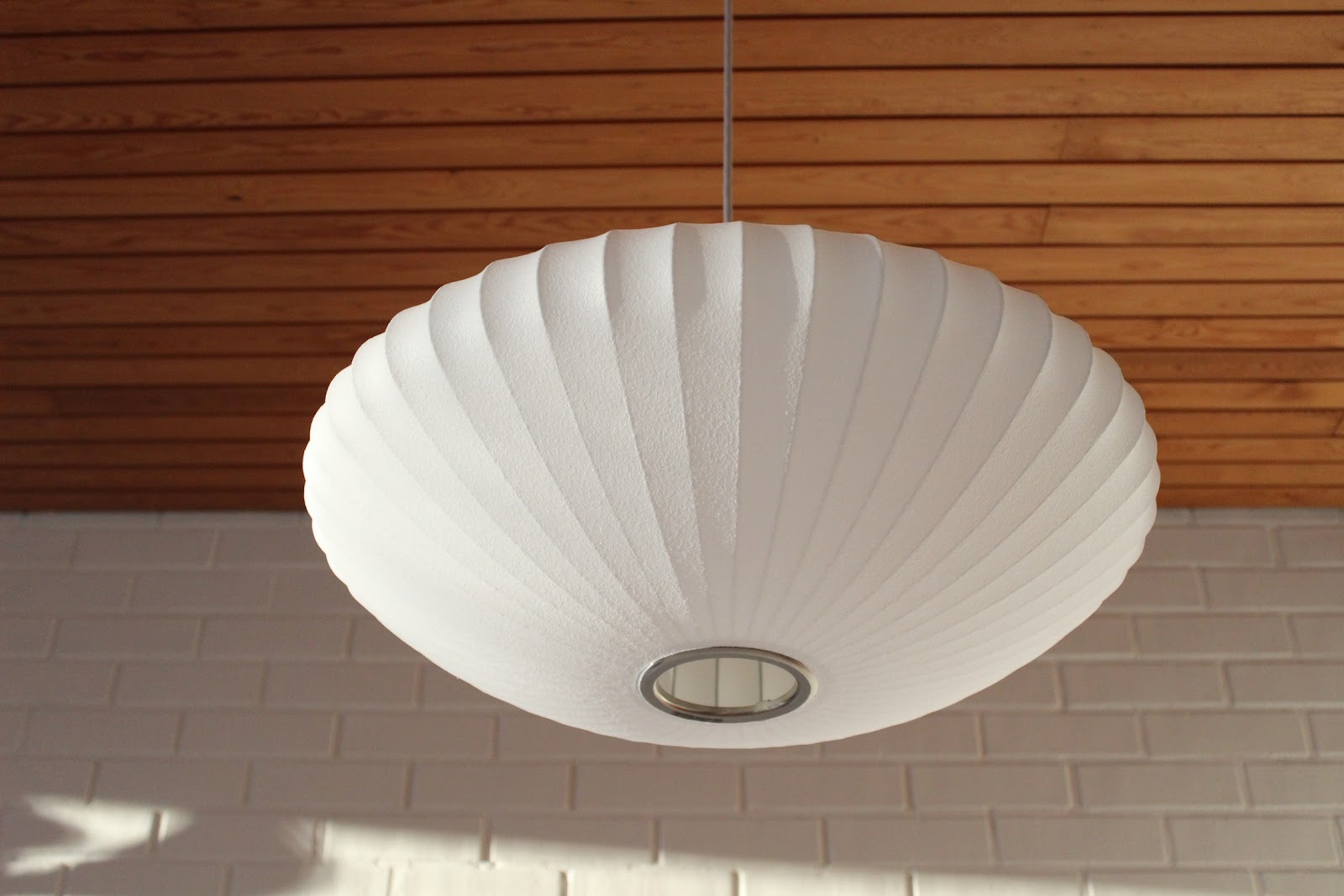
Another interesting topic is the choice of the dinner table light. Many of you know and might even have the Lokki light (also known as Lentävä Lautanen, the Flying Saucer) by Yki Nummi. Very few lights have gained such a prominent national status as the Lokki in Finland or the famous PH5 by Henningsen in Denmark. The George Nelson Bubble lamp has a very similar status in USA. It became the mid century pendant light of choice by the Average Joe. We usually prefer vintage, but in this case we chose a later production series instead, as the cover material in the older lights tends to turn ugly yellow with age.  

Nelson Bubble Light by Modernica

Those of you who visited our old apartment might remember our old ROUND dining room table. As we now have a bit more space and aim seating eight diners at the same time, we "upgraded" to a Piet Hein's Superellipse manufactured by Fritz Hansen...well, almost. When searching for a large round table to our old apartment, we came to notice they weren't widely available. Therefore, we bought a set of original legs from an auction house and ordered a custom made table top separately. Now, it was easy to change the table top to something which greatly reminds the Superellipse (Our apologizes, Piet!). We usually don't like cutting corners this way, but somehow this can be justified by significant wear and tear caused by kids. 

DIY superellipse

So if you are wondering which dining room chairs we have set our minds at after selling the Eames chairs? Well, keep on reading the blog and you will find out, as the HDP model is actively being used in chair search!

Dec 29, 2012

Final frontier - completed

There is a little room upstairs which has been less spoken of until now. Referring to the floor plan, it is the farthest one of the two small rooms planned to be a combined study and a guest room. The cupboards in this room were already painted at the same time with the rest of the cupboards and floor sanded and lacquered in the very beginning of the renovation project. However, because we have had no urgent need for this room, the old and ugly wall paper has remained in place and it has effectively served as a storage for all the tools, paints and other renovation gear.

Starting point
While we were renovating - the gear graveyard

A few weekends ago the time came, when Pekka started the final battle with the study which was the last room needing work upstairs. After dumping all the renovation junk downstairs he removed the old wallpaper and painted the walls white. Now, after moving in we have noticed an interesting phenomenon: the threshold of starting any renovation related task seems to grow greater by the day, even if the to do list is still quite long. After finally finishing whatever a task in question happens to be, we always wonder how on earth it took so little time even if the time spend procrastinating with it was so enormous.

Rip me off

Anyhow, the study is now painted, furnished and ready for use, so few lines of the end result are in place. On the left wall, we have a vintage String unit with teak finish, which was found through eBay while still living in our previous apartment. When we moved here in September, the String shelf was first placed in the living room on the wall where we now have the Vodder credenza. It fits much better, however, to the study both from functionally and visually. It is quite a large system, and thus for the study we used only part of them leaving the rest of the pieces for other rooms.

The String shelf system is very well known also outside the collector community, but it's story might not be quite as familiar for the many String owners. It was created by Nisse and Kajsa Strinning in 1949 for a competition initiated by Bonnier public libraries. The goal of the competition was to create an assembly and expandable book case. The Strinnings' design won the competition and was exhibited in the H55 exhibition in Helsingborg in 1955, then becoming a huge sales success in 1960's. The shelf system consists of veneer shelfs hung on plastic coated wire ends, and it is still in production in many different colors and materials.

String shelf system and Nesso lamp

The study room also offers a home for three different lamps. The orange Nesso lamp in the picture above was designed by an Italian designer Giancarlo Mattioli for Artemide (1967). In the photo below is the PH Kontrast lamp, which is a base model of the current snowball pendant. The PH Kontrast was originally designed by Poul Henningsen for Louis Poulsen in 1958-1962 but due to the elaborate details, it cost too much to produce so it was discontinued in 1970's.

PH Kontrast and Sunburst by George Nelson

The chair next to the table is a Bellini chair designed by Mario and Claudio Bellini for Heller USA (1998). This chair was still in development at Atelier Bellini in Milan when Pekka started working there as a designer. We actually have two of them and they belong to the so called 0-series, which is the series following the prototypes in the product development process. Therefore one can see the marks of trial and error of injection molding, which are absent in chairs in later production series.

Bellini chair and PH80 by Poul Henningsen

In the far end of the study two items remain which in the long run do not belong there at all. The first one is a very unpractical and large sliding door, which used to separate the kitchen and the living room, but was removed while renovation. It is yet to be decided whether we are going to use it or not, but until then this massive and ancient door is going to roam from room to room, wherever it happens to bother us the least. The Bubble chair by Eero Aarnio (1968) is waiting for summer, as it will be then place on the upstairs atrium terrace.

The sliding door and a Bubble chair

Dec 25, 2012

Three C's and a floor lamp

In the living room, there are still few more details we'd like to share with you more closely. Thus in today's posting, we'd like to address the ceiling, a couch, a coffee table and a floor lamp.

First, the ceiling. It has actually been quite a controversial topic from the very beginning. It basically divides people in two categories: to those who insist it to be painted white, and those who prefer it unpainted. From the start, we have belonged to the latter category, and thus the ceiling remains unpainted, whereas the red brick walls were painted white. Together, the wooden ceiling and white brick walls create a very inviting, natural, and Scandinavian look.


The view from the front door

Most of our furniture and lights are vintage, more specifically from the 1950's. The couch, however, is new, as couches from 1950's are small in size and not very well acclaimed for their coziness. In addition, we wanted the couch to be visually light but still somehow match the 1950's style prominent in the apartment. Therefore, we turned our eye on the Italian maestro Piero Lissoni, known for great couch design over the years. 

The sofa in question, called Toot, is manufactured by Italian company Cassina (2009) and fullfills all our preset criteria. It is also a great platform for a bunch of Kilim pillows (another obsession from the past). Naturally, the pillow colors were chosen to round up the color palette of the home.


Long enough for a lengthy dog?

Next, in front of the Toot sofa is a coffee table from another maestro, Danish modernist Hans J. Wegner. The table in our living room is called AT10 and it is manufactured by Andreas Tuck (1955). It is made of solid teak and has an underlying shelf made with woven cane. Wegner is considered one of the most influential furniture designer of the 20th century, thus being a synonym for the mid century Danish design. Over the years, he has designed over 500 different chairs with many different wood types and styles. The carpet under the table is from Artek.


Solid teak top with a raised edge

Behind the Toot sofa is a curtain made of wooden sticks. This is something which was originally prepared for our previous place to separate the foyer and the living room. When we moved in, it was delighting to notice the wooden curtain fits perfectly on the big windows without any major modifications. The large windows are beautiful and give character to the apartment, but the downside becomes noticeable during the winter: although the apartment is generally quite warm, the windows tend to radiate cold when the temperature drops below the freezing point. 


Wooden curtain

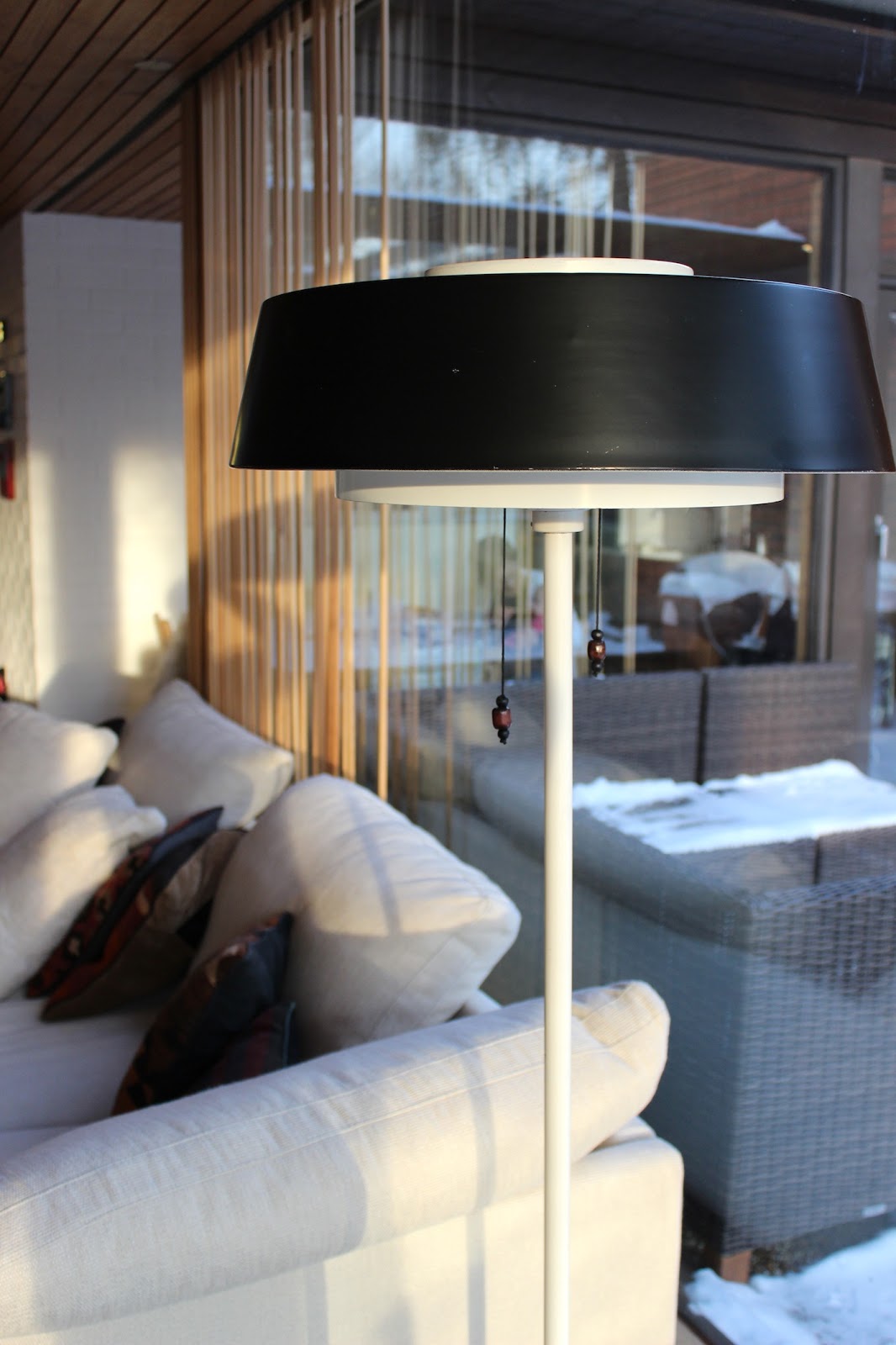
In the far end of the couch is Pekka's favorite piece of lighting, a floor lamp manufactured by company called Hiemstra Evolux from Amsterdam. The floor lamp is a real Dutch vintage design classic (1955), with a typical late fifties color scheme. It is not quite sure who is the original designer, but it is thought to be attributed to Leo Rutjens. The floor lamp provides both direct (downwards) and indirect (upwards) light. It is another one of those items which just all of a sudden appeared out of nowhere...


Hiemstra Evolux

And guess who loves the Toot sofa most of all? In Urho's opinion, the couch and the Kilim pillows are a perfect match to accommodate his needs, which basically revolve around relaxing, sleeping and just general procrastination. 


Don't mind modeling at all...