
As the terrace is located above the ground level, in addition to the visual and functional dimensions we also needed to consider safety. For example, one of the initial ideas - the couch next to the railing - was shot down pretty quickly after we had some young visitors very keen on climbing. Another important factor affecting the layout was the direction of sun light. As the terrace faces south, the sun crosses it sideways between 10 am and 6 pm. To maximise the amount of sun, the couch is now placed next to the west wall, the last spot receiving direct sun light in the evening. This way the couch is also not blocking the view from inside enhancing the interaction between in- and outside spaces.
 |
| General layout of the terrace |
The pieces were selected to complement the Aarnio bubble chair. At the centre is a low coffee table made of metal and recycled teak. Next to the table is a weather resistant couch. And with resistant, we really mean resistant! The coach cushions can be left out in the rain and once the rain is gone, they dry extremely quickly. Quite practical!
Around the table there are two LCM chairs by Charles and Ray Eames. These chairs used to reside in the living room, but being approximately the same height than the couch they turned out to be a great addition around the coffee table. Naturally, as they do not handle rain very well, they need to be brought back inside if it is raining. Fortunately they are quite light, so transport back and forth depending on the weather is not a major effort.
Overall, we are really pleased with both the style and functionality of the terrace. Being visible from most parts of the top floor we wanted to decorate it with the same style as the rest of the apartment. During the summer months, it is really like an additional room. The close location of the kitchen next to the terrace is also convenient when preparing food for barbecue. Since the arrival of the grill, it has been in active use, but being rather large and not very pretty we placed it between the couch and railing. This way it is not in anyone's way and when in use the smoke escapes away from the terrace door.
 |
| An inviting view from the kitchen |
Based on the past month's experiences, we are now even more convinced the Profi Deck material was definitely the right choice for us. Both visually and practically, it compliments both the terrace and our needs. The colour is in line with the structural wood work, and the decking boards have been laid in the same direction as the overhanging wooden structure and the inside ceiling. However, even more than the visual reasons, the deck boards are laid in this direction because the floor has a slight decline towards the railing. Assembling the Profi Deck with the rubber strips creates a water proof decking allowing the rain water to flow towards the drains, which are located next to the railing. This way the deck dries faster and the water flow also helps to clean the deck from dust and other particles.
 |
| The view from the railing |
One of our latest auction finds also ended up to the terrace - a rattan ottoman designed by Franco Albini for Vittorio Bonacina in 1951. Pekka has been hunting this piece (two of them, actually) for more than a year now and finally the first one found it's way to our terrace! This rattan-made piece also belongs to the permanent collection of MoMA New York. Rattan is a natural material which grows mainly in the Far East, and its characteristics include elasticity, flexibility and lightness. The stool is woven by experienced, specialised artisans, and is stunningly beautiful, practical and yes, of course, vintage!
 |
| Ottoman by Franco Albini for Vittorio Bonacina 1951 |
The LCM's by Eames are roughly from the same period than the Albini ottoman. The design of the LCM's actually derives from the early 1940's when Charles and Ray Eames were experimenting with wood-molding techniques. Their studies led to a commission from the US Navy requesting the Eames couple to develop plywood items used in the WWII. Later Charles and Ray applied the same technology (molding wood and glue under heat and pressure) to make affordable, high-quality veneer chairs, which could be mass-produced using dimensionally shaped surfaces.
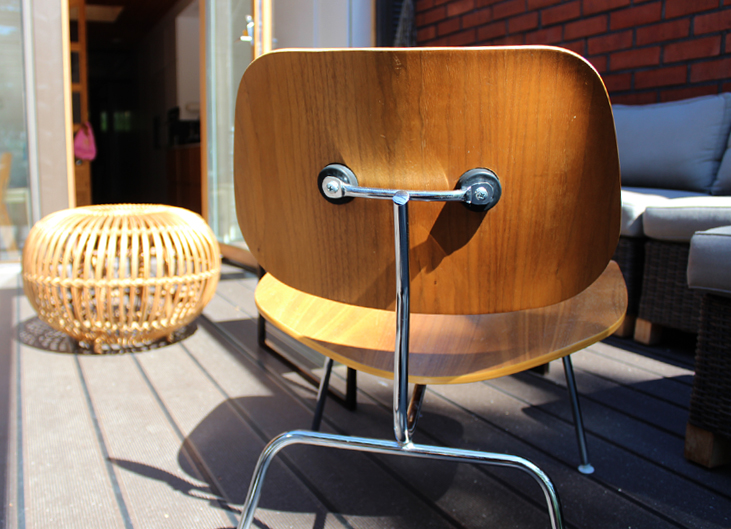 |
| LCM by Charles and Ray Eames for Herman Miller 1946 |
The plywood seat and backrest of the LCM are joined to the metal spine and legs with a series of rubber washers or "shock mounts". The shock mounts are glued under the seat and behind the backrest and screwed to the metal frame. The rubber mounts allow the backrest to flex with the person sitting in the LCM. Unfortunately, this is the greatest design flaw of the chair. The shock mounts are securely glued to the wooden backrest, but can tear free if excessive pressure is applied or when the rubber becomes brittle with age. It is not very uncommon to see vintage chairs to which holes have been drilled through the plywood to use screws to attach seat and backrest to the frame. Such a shame.
The only two companies producing LCM's chairs are Herman Miller in US and Vitra in Europe. Since the launch of LCM's they have become available in several different wood finishes and colours. Our chairs have a walnut finish and are made by Herman Miller.
 |
| LCM's with Ottoman |
On a completely other topic, there have been two recent landmarks in our little daughter's life: she just celebrated her first birthday, and a bit after that, learned to walk. For her birthday present, she received a beautiful flower from her grand mother.
 |
| Flower on teak |
Just like us adults, also the junior members of the family are really enjoying the sunny terrace. Also, we brought the plants out for the summer to allow them to take advantage of the short sunny summer months of the Scandinavian summer.
To conclude, it is now a bit difficult even to remember the terrace before the transformation. We just love it! To us, the Profi Deck is a perfect solution: it has a flexible design and is easy to install and maintain (even the worst barbecue messes have been easy to clean). It is also visually appealing and very pleasant to walk on. Finally, an important attribute for us was also the fact that the Profi Deck material is upcycled, and thus in line with our goal to conserve as much of the original elements of the apartment as possible and reuse recycled materials wherever feasible. Therefore, we are glad to recommend the Profi Deck solution for anyone. If you want to come and check it out, you are most welcome!
 |
| Two happy juniors |
To conclude, it is now a bit difficult even to remember the terrace before the transformation. We just love it! To us, the Profi Deck is a perfect solution: it has a flexible design and is easy to install and maintain (even the worst barbecue messes have been easy to clean). It is also visually appealing and very pleasant to walk on. Finally, an important attribute for us was also the fact that the Profi Deck material is upcycled, and thus in line with our goal to conserve as much of the original elements of the apartment as possible and reuse recycled materials wherever feasible. Therefore, we are glad to recommend the Profi Deck solution for anyone. If you want to come and check it out, you are most welcome!


