Showing posts with label Nelson. Show all posts

Aug 23, 2013

Dining set - revisited

Finding the right pieces at the right time is not always easy.

You might remember we had some challenges with the dining set. This crucially important project seems to be eternally fluctuating between random progression and inevitable reverse, and is really not expected to be completed any time soon. However, being such a dynamic process it deserves some attention, and thus we thought a report of the current status would be justified. To revise the story so far you can also scan through these two posts: (1 & 2).

So, we did find another Cherner chair and once again Pekka invested several hours in restoration so the chair could actually be used for sitting again. Even if it most certainly is a stunningly beautiful chair, unfortunately it doesn't match the rest of the set. The wood used in plywood is birch, whereas the rest of the set is made of walnut. Another mismatch is the lack of upholstery. We would actually prefer the complete set without upholstery (at least from the visual perspective), however, considering dinners usually tend to take more than 15 minutes, a chair with at least some softness to sit on is just much more comfortable.

Because of these two issues, we decided to continue searching for two Cherners to better match the existing walnut set of four. As a consequence, we also decided to say goodbye for the beautiful single birch made chair, and were really glad that in the end, it found a new home with of a good friend and a true collector who really appreciates its beauty.


Two Cherners and a dacshund

Related to the picture above there is a funny story to share about Urho. As you might have noticed, every now and then we have kindly requested our beloved dachshund to strike his best pose and model in the blog shots. After a photo shoot he always receives a treat for a job well done. Apparently, the number of repetitions has reached a critical point, and the smarty sausage has figured out the link between camera and treats! Now, every time Pekka pulls out the camera Urho quickly arrives to the scene, extends his lengthy figure and models patiently in the front row. What a great team member!

But back to the Cherners. We are very proud to present the complete set of six! It took Pekka about eight months to find all of them, but finally a matching set of two armchairs and four side chairs is complete. Interestingly, all of these wonderful chairs arrived from the Sunshine state of Florida. We are quite happy!


The whole family

Just like the side chairs, the new armchairs have a walnut finish and black vinyl upholstery, and they were also manufactured during the same period (early 1960's). The are stunning - just like with so many vintage items, the decades of encounters with users have left behind characteristic marks and imperfections of life making them unique and beautiful.


Vintage beauty

There is slight variation in the level of shininess in the vinyl naugahyde upholstery between the side chairs and the newly arrived armchairs. Fortunately for Pekka (and his continuously growing toolkit of restoration necessities), this is nothing to worry about. The shininess can and indeed will be adjusted later perfecting this slight visual mismatch!


Arm- and side chairs

Having all six chairs finally around the same table feels like a mission accomplished - well, at least partly. The set really screams for a carpet, which would nicely define the dining area. One of the options we are considering is some type of sisal carpet, but this has not been locked yet. It also has to be admitted that we are currently in negotiations for a new dining table (fingers crossed). This is quite exciting of course, and something we will definitely return to later on.


The set (and the dog)

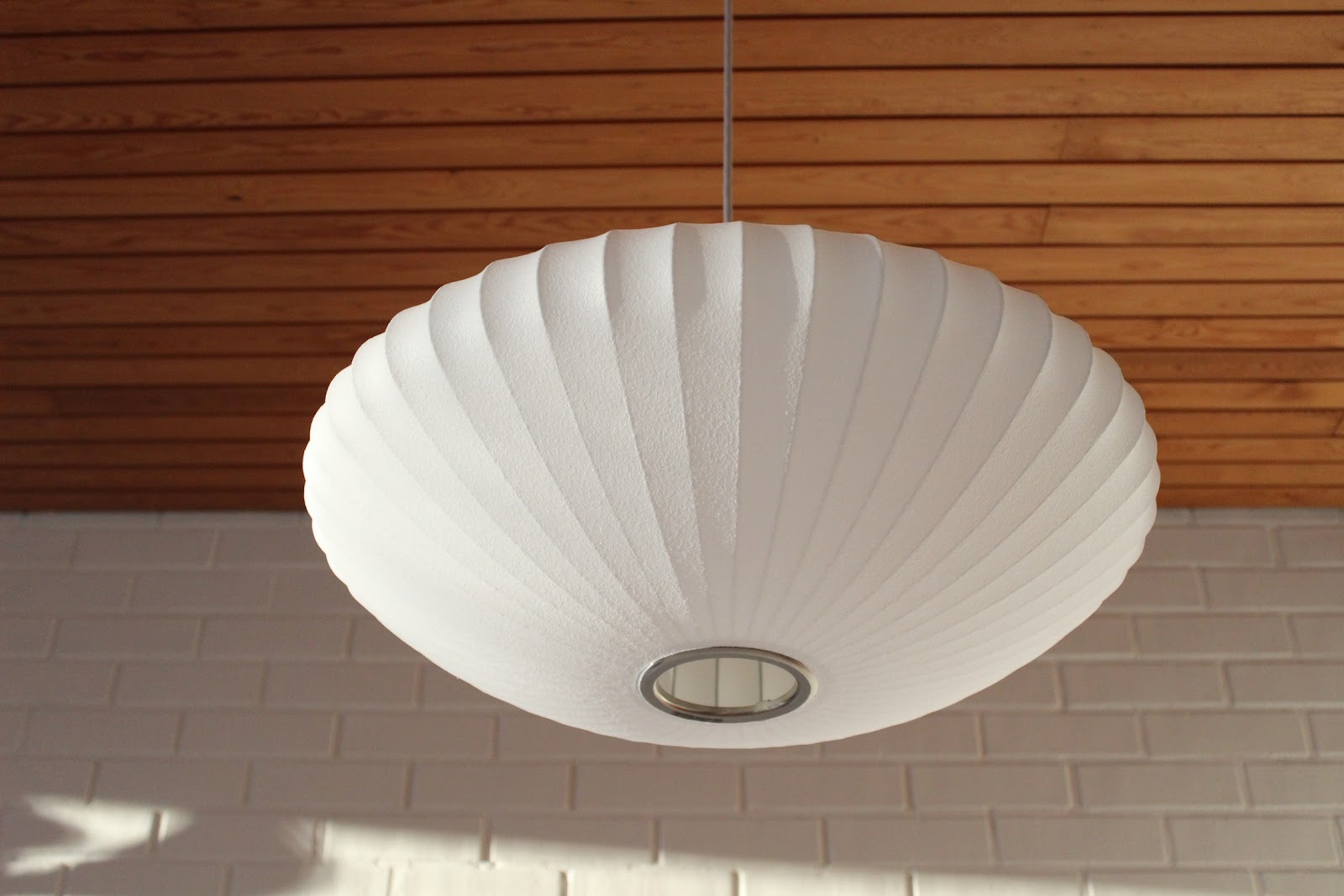
Last but not least - anyone noticed that the Bubble light by George Nelson which used to hang above the table has given way for another pendant? This also something we will return to shortly, so if you are interested in reading about a complete transformation of a vintage PH Artichoke by Poul Henningsen currently shining above the dining table, stay tuned...

Feb 16, 2013

The Cherner Chair

Remember the problem concerning the dining room chairs we addressed in the Round of Excuses posting? Briefly, after switching to a larger, elliptical table, we noticed there is no way to fit two DAWs between the table legs. Therefore, a global hunt for new chairs was initiated and finally we are delighted to report the most recent success of the HDP model!

The chair of the choice is the Cherner chair, by Norman Cherner for Plycraft (1958). Four (out of desired six) arrived to our home about a week ago from Florida. They are vintage (naturally), beautiful and fit nicely on the sides of the table. These chairs are made of plywood walnut veneer with a vinyl naugehyde upholstery. The search still continues, however, for two armrest versions of this same chair, which will be placed on each end of the table.

Cherner chair by Norman Cherner for Plycraft (1958) 

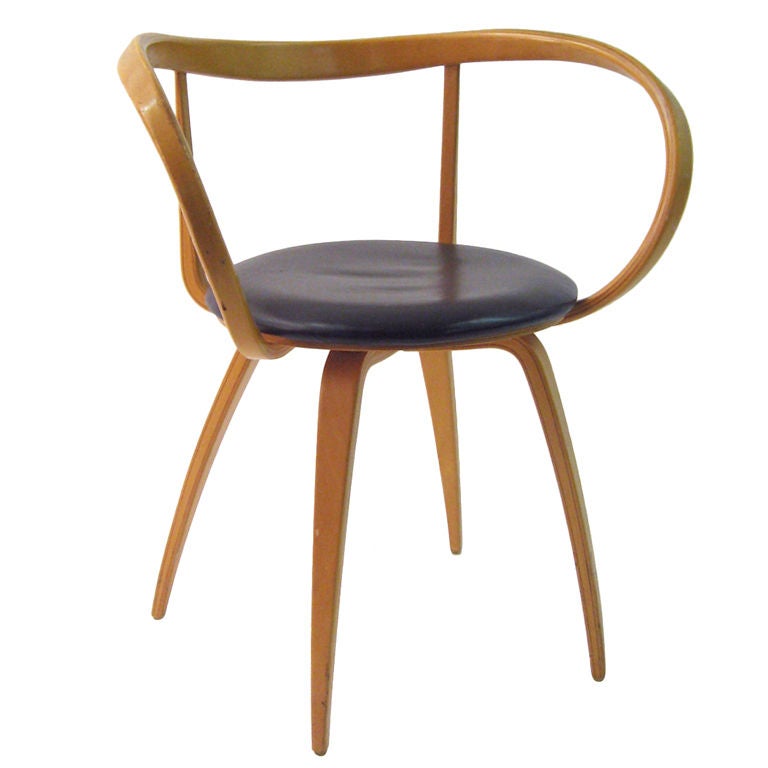
There is actually an interesting story behind the Cherner chair. In the 1950's, the Herman Miller company, led by George Nelson, wanted to create a lightweight chair out of plywood. However, the pretzel chair, designed by Nelson's office in 1952 and produced by another US company Plycraft located in Lawrence Massachusetts, was too fragile and costly, so the production was stopped in 1957.

At this point, Plycraft didn't want to waste the tooling, materials and techniques they had for constructing plywood furniture. Therefore, George Nelson recommended that Norman Cherner would design a sturdier and more economical Pretzel-like chair. Subsequently, Paul Goldman, the owner of Plycraft, hired Cherner. After turning in his design to Plycraft, however, Cherner was told the project had been stopped.

Curiously, a while later Cherner ran across his design in a furniture showroom in New York. Based on the label, he saw it was manufactured by Plycraft and designed by "Bernardo". As a result, Cherner sued Plycraft in 1961, won and received his royalties. Goldman also admitted that Bernardo was a fabricated name. Because of all this sometimes the design is mistakenly also attributed to either Paul Goldman or George Mulhauser. What a mess!!

Afterwards, Plycraft continued to produce Cherner's chair, but it was still difficult and expensive to produce. They continued to modify the original design over the years, leading to some visual variability among the vintage chairs. Ultimately, because of these difficulties the chair remained in production only until the 1970's. Cherner's sons have recently reissued their father's original designs with a company called Cherner Chair Company so a newer option exists for those who prefer new over vintage.


Label underneath our chairs indicate that they were produced after the law sued (1964)

So back to our fantastic four. After a long search we actually happened to find our chairs from Miami, USA, and they finally arrived about a week ago. Excited to see how they looked, felt and matched with the rest of the dining room, Pekka unwrapped and assembled the chairs right away.


Fresh from the Helsinki airport customs

Cherner chairs waiting to be assembled

And these four chairs are simply stunning! Someone has stated that these are the most beautiful pieces of furniture ever made out of plywood - and yes, we absolutely agree! What makes them stand out from their plywood rivals is the graduated thickness of plywood. This can be seen both on the legs and the seat. It is this structural feature that eventually enabled also the most important design cue of the Cherner chair: the narrow waist. The graduated thickness, together with the flowing shape of the armrest, were additional features making this chair difficult and expensive to manufacture. Considering all this, it is easy to see why this particular design is very difficult to copy. This is also the reason why there are so few knock-offs in the market, and if you happen to find one it would be fairly easy to distinguish a knock-off from an original.

Cherner beauty

And not only these four chairs are amazingly beautiful, they are also in exceptional condition! Manufactured in 1964 they are now nearly 50 years old and practically flawless. It is almost as if they landed to our home in a protective time capsule from a bygone era. It makes you wonder where they have spent the past 50 years - unused in some warm storage room, maybe?

Label from 1964

The foot pads, intact and like brand new. Yet, they are almost 50 years old!

At this point, we would like to present our sincerest regards to the person who sold us these beautiful chairs, Anna from Miami (dosbananos in eBay). This purchase was definitely one of the smoothest, fastest, and most reliable processes we have ever experienced. So please take note, if you are looking for a design item from the North American market. Please do not hesitate to contact her - we are glad to give her our highest recommendations!

And just to conclude - what did Urho think of all this? Honestly, he could not care less. After all, they are just chairs. Way too high for a sausage dog to enjoy them.

While you are working on those chairs, let me just rest my eyes for a minute...or two!

So the problem with the dining room chairs is now solved. Right? Well, not exactly. With the new chairs, the table no longer looks as nice as it once did...

Jan 6, 2013

Round of excuses

There are two goals for this posting. First, to introduce the last part of the living room which you have not seen yet - the dining area - and second, to discuss a major dilemma regarding the dining room chairs.

The dining area is located next to the Vodder credenza. It consists of a table for eight people, chairs and a light above the table. As you have seen in the previous postings, we also have a separate breakfast table next to the kitchen, but in addition to this we thought it would be nice to have space for group of eight diners. Easier said than done.

Looking out for snacks

The question which dining room chairs should one choose can be a tricky one. Of course, the perfect chairs do exists being a set of Kjaerholm's PK9 in cognac leather or Wegner's CH24 Wishbone chairs. However, the Kjearholm ones happen cost a small fortune thus being absolutely out of our range, and the Wishbone chair seats are woven paper cord (not a great match with small children, and they are bit of a cliche anyway). Therefore, we are forced to consider other alternatives. Up until now we have been quite happy with our current choice, the Eames plastic DAWs by Vitra. The DAW is an arm rest version of the famous Eames plastic chair, which was launched in 1948 for the Museum of the Modern Art low cost furniture design competition, being the very first industrially manufactured plastic chair. 

The DAW was originally produced by Zenith plastics in Los Angeles as a fiber glass version (the famous rope edge chair). However, due to the environmental pressures both Herman Miller and Vitra started to produce it in injection molded version, which are the ones we currently have. Originally, this chair was launched with a rod base, and the DAW base which we have in our chairs was actually used for a very short time period during the 1950's. It was brought back to manufacturing only several years later. The chair works well around the table but also equally nicely as a side chair or a study room chair.

Eames DAW

As much as we like the Eames plastic chairs, they have one fundamental problem considering our dining room. We would like to fit two chairs on each side of the table and one on each end, but unfortunately there is not enough space between the table legs on the sides for two chairs to be pushed under the table when not used. Having eight of them would be just too much, even in temporary use. Therefore, all four chairs are on sale in Huuto.net, either as single items or as a set of four. If you are interested, do not hesitate to contact as by email (theolivegreenwindow@gmail.com). 

Another interesting topic is the choice of the dinner table light. Many of you know and might even have the Lokki light (also known as Lentävä Lautanen, the Flying Saucer) by Yki Nummi. Very few lights have gained such a prominent national status as the Lokki in Finland or the famous PH5 by Henningsen in Denmark. The George Nelson Bubble lamp has a very similar status in USA. It became the mid century pendant light of choice by the Average Joe. We usually prefer vintage, but in this case we chose a later production series instead, as the cover material in the older lights tends to turn ugly yellow with age.  

Nelson Bubble Light by Modernica

Those of you who visited our old apartment might remember our old ROUND dining room table. As we now have a bit more space and aim seating eight diners at the same time, we "upgraded" to a Piet Hein's Superellipse manufactured by Fritz Hansen...well, almost. When searching for a large round table to our old apartment, we came to notice they weren't widely available. Therefore, we bought a set of original legs from an auction house and ordered a custom made table top separately. Now, it was easy to change the table top to something which greatly reminds the Superellipse (Our apologizes, Piet!). We usually don't like cutting corners this way, but somehow this can be justified by significant wear and tear caused by kids. 

DIY superellipse

So if you are wondering which dining room chairs we have set our minds at after selling the Eames chairs? Well, keep on reading the blog and you will find out, as the HDP model is actively being used in chair search!

Dec 29, 2012

Final frontier - completed

There is a little room upstairs which has been less spoken of until now. Referring to the floor plan, it is the farthest one of the two small rooms planned to be a combined study and a guest room. The cupboards in this room were already painted at the same time with the rest of the cupboards and floor sanded and lacquered in the very beginning of the renovation project. However, because we have had no urgent need for this room, the old and ugly wall paper has remained in place and it has effectively served as a storage for all the tools, paints and other renovation gear.

Starting point
While we were renovating - the gear graveyard

A few weekends ago the time came, when Pekka started the final battle with the study which was the last room needing work upstairs. After dumping all the renovation junk downstairs he removed the old wallpaper and painted the walls white. Now, after moving in we have noticed an interesting phenomenon: the threshold of starting any renovation related task seems to grow greater by the day, even if the to do list is still quite long. After finally finishing whatever a task in question happens to be, we always wonder how on earth it took so little time even if the time spend procrastinating with it was so enormous.

Rip me off

Anyhow, the study is now painted, furnished and ready for use, so few lines of the end result are in place. On the left wall, we have a vintage String unit with teak finish, which was found through eBay while still living in our previous apartment. When we moved here in September, the String shelf was first placed in the living room on the wall where we now have the Vodder credenza. It fits much better, however, to the study both from functionally and visually. It is quite a large system, and thus for the study we used only part of them leaving the rest of the pieces for other rooms.

The String shelf system is very well known also outside the collector community, but it's story might not be quite as familiar for the many String owners. It was created by Nisse and Kajsa Strinning in 1949 for a competition initiated by Bonnier public libraries. The goal of the competition was to create an assembly and expandable book case. The Strinnings' design won the competition and was exhibited in the H55 exhibition in Helsingborg in 1955, then becoming a huge sales success in 1960's. The shelf system consists of veneer shelfs hung on plastic coated wire ends, and it is still in production in many different colors and materials.

String shelf system and Nesso lamp

The study room also offers a home for three different lamps. The orange Nesso lamp in the picture above was designed by an Italian designer Giancarlo Mattioli for Artemide (1967). In the photo below is the PH Kontrast lamp, which is a base model of the current snowball pendant. The PH Kontrast was originally designed by Poul Henningsen for Louis Poulsen in 1958-1962 but due to the elaborate details, it cost too much to produce so it was discontinued in 1970's.

PH Kontrast and Sunburst by George Nelson

The chair next to the table is a Bellini chair designed by Mario and Claudio Bellini for Heller USA (1998). This chair was still in development at Atelier Bellini in Milan when Pekka started working there as a designer. We actually have two of them and they belong to the so called 0-series, which is the series following the prototypes in the product development process. Therefore one can see the marks of trial and error of injection molding, which are absent in chairs in later production series.

Bellini chair and PH80 by Poul Henningsen

In the far end of the study two items remain which in the long run do not belong there at all. The first one is a very unpractical and large sliding door, which used to separate the kitchen and the living room, but was removed while renovation. It is yet to be decided whether we are going to use it or not, but until then this massive and ancient door is going to roam from room to room, wherever it happens to bother us the least. The Bubble chair by Eero Aarnio (1968) is waiting for summer, as it will be then place on the upstairs atrium terrace.

The sliding door and a Bubble chair