Showing posts with label Herman Miller. Show all posts

Nov 7, 2014

Early Edition 670 & 671, Part II

This post actually belongs to a series of updates dealing with a restoration of an early series 670 & 671, or better know as the Eames Lounge chair. The "series" might sound a bit of an overstatement as as the last related story was released almost one year ago...yes, point taken - we really need to shape up a bit! Anyhow, if you want to revisit the earlier parts you can find them here: 1 & 2.

So, back to the key character of the story - The Chair. After the initial assembly and first inspection (the chair had been disassembled for transportation) it was evident it needed to be disassembled again and work on the separate components should begin.

The frame

The first thing to do was to remove the cushions. It was easy to just unclip and slide them off the panels. Then off came the armrests, which are fixed in place with three screws in this early model. Later models have only two screws attaching the armrests to the metal brackets.


Early armrests with three screws

Next, the metal brackets on both sides of the chair fixing the backrest to the rest of the assembly were separated by removing four screws. When loosening the screws one should be very careful as the weight of the backrest starts quickly forcing the backrest down and if not supported properly, the wooden parts can easily break. Subsequently, the two backrest panels were separated from each other.


Armrest metal bracket

After the rosewood seat and backrest panels were taken apart from each other the die casted aluminum base was detached from the seat and ottoman panels. This was done by loosening four screws. 


Ottoman base

Once the chair was fully disassembled to individual components its dirtiness was even more evident. The entire structure was covered with years of dirt combined with a suspicious mix of old surface treatments. Additionally, the wood panels were very dry and desperately screaming for some oil.

Rosewood seat panel

Before the wood could be retreated with oil it was important to wash the panels throughly. A good approach is to use steel wool together with some sort of cleansing liquid. Pekka used a commercial cleansing liquid made specifically for furniture (there are several brands available to choose from). Alternatively, you could also choose to use methylated spirit or mineral spirits for cleaning. Whatever your preference, it is important first to try it on an area which is not visible to the eye, such as an area covered by a cushion. It is also good to do the cleaning in a well ventilated area or even outside as the evaporating fumes will make your head hurt if working in a closed, small space.


Seat panel - before

Pay attention when using steel wool on veneer. Rub it only to the direction of the grain, otherwise you might scratch the wood and leave unwanted marks. Be also careful when working on the areas where brand labels are located as you don't want to damage them either.

Use clean rags or household towels once you start rubbing the wood with cleansing liquid. As soon as the dirt starts coming off the panels do not smear it all over the panel, but rather wipe it off with a clean rag. Next, add more fresh cleansing liquid to the steel wool and repeat the same procedure to the rest of the panel.


Working with steel wool

After the panels are clean and dry it was time to start the most rewarding part of the restoration: applying the oil. Again, patience is a virtue: the oil can't be applied on a wet wood, ever. Depending on the ambient conditions and preferrer cleansing liquid with you may need to wait for a few hours or even to the next day just to be sure all the liquid have evaporated from the surface to be treated.


Panel-oil and a dachshund's snout

There are several types of oils to choose from. Some brand names indicate what the product actually contains (such as pure tung oil) and others are just names (such as tung oil finish) created by marketeers and might have little or nothing to do with the actual oil composition. The content of these products usually varies being usually a blend of some sort of oil, varnish and hardener, and perhaps not be the best choice for a vintage chair. Whichever oil you choose make sure you know how it will behaves on the surface to be treated, just to avoid any unpleasant surprises. Originally, Herman Miller used gun stock oil - so take a wild guess what Pekka chose for our chair?

Half washed, half oiled


After careful cleaning and treating, it is certainly a pleasure to see how the oil gives richness to the wood tones and really makes the grain pop. Yes, freshly oiled Rio palisander is indeed one of the prettiest sights we know!


Freshly oiled rosewood

In the next part of the series (promised, it will not take another year) we will show what happened to the base, domes of silence and the shock mounts. So please stay tuned!


Aug 11, 2013

Early Edition 670 & 671

In the short history of the Olive Green Window, a story that has drawn the attention of most readers is the Eames Lounge Chair post written in January 2013. As this topic is clearly very interesting, we would now like to continue with this theme. It is also an acute topic - those of you who have recently visited the "past items" section might have noticed the late sixties lounger has moved out - yes, also one of the Cherner chairs is gone. More about that later. 

Left without a chair in functional and presentable condition, Pekka is now "forced" to finish the restoration of the early edition Eames Lounge Chair we have had stored away for more than a year. At the moment the chair pieces lay in the living room corner, disassembled and waiting the new leather upholstery and shockmount installation to be finished. Usually projects of this kind are performed downstairs in the Man Cave. Unfortunately, Pekka's beloved cave is now fully booked, as it serves a storage sentence of an undefined length due to downstairs renovation. So yes, Minna has to, once again, deal with piles of furniture components in the lounge. This is, however, nothing new to her - this comes with the package when you choose to share your life with a collector!


Pieces waiting to be assembled


We actually found this particular Eames piece when we were still living in our old apartment, so thus you get to see some pictures from there as well! Anyways, the story started last summer, and like so many times before, Pekka was conducting an extensive global search with extremely strict criteria. Finally he spotted this early edition chair through eBay, located in Chicago, US. It was a relatively risky commitment, especially when the decision needed to be made based on just a few pictures available in the internet. Once again, after some serious consideration, we just had to trust our intuition.


Two boxes from Chicago

After a purchase like this, the moments of unwrapping can be very intense - after all, this is the first time you see the item "in person". As expected, inside these two boxes were a disassembled lounge chair and a ottoman, extremely well packed. This is actually something we are delighted to see quite often - the effort and care put into packing demonstrates that people selling items like this appreciate their value and wish to protect them as well as possible for their journey. In this case, we had been given an option to send it back if not satisfied.


Ottoman with chair components

So, when the chair was assembled again it was finally time to inspect it at a close distance. We knew already knew it would be an extensive restoration project as the chair was more than fifty years old, but how extensive exactly? Luckily it was good news. The condition of the rosewood panels and metal parts was surprisingly good. There were also no unfortunate quick fixes, such as for example "fixing" a chair with collapsed backrest by drilling holes through the lower panel in order to to secure it with bolts. That happens, and would have been such a shame.


Early edition Eames Lounge Chair

When previously discussing the Eames Lounge Chair, we presented that based on structural differences found in these chairs, one could estimate the approximate year of production of each chair. However, one also has to understand that naturally these structural changes did not happen overnight, but rather gradually instead. Also, the background information we have is based on literature and internet sources, and sometimes there are differences between various sources. Against this background, it is understandable to argue with the logic of dividing the different chair generations to "series" as we called them. In essence, we believe the classification approach works best when considered more as a rule of thumb providing guidance, rather than exact, black and white metrics.

Our current chair has several features which are typically found in the Herman Miller made, american chairs from the '50 to early '60. Given the relatively small production series of the early years, it seems that this particular chair would fall among the first few thousands of chairs produced. We discussed about these features in more detail in the previous Eames Lounge chair post, but before launching the restoration saga let us briefly revise the different structural features and the general condition of this chair.

First, underneath the chair resides an intact metallic medallion glued to the rosewood indicating the designer and manufacturer. This type of label was one of the first labels used in these chairs.


Manufacturer label


Second, the wood used in the visible, top layer of the plywood is Brazilian rosewood (Dalbergia Nigra). Like the length of ladies' dresses has varied through time depending on the moody winds of fashion, also the texture of the wood grain used in Eames Lounge Chairs has varied from decade to decade. The very dark rosewood, with only a slight variation between different grain shades is typical to early Herman Miller chairs. Thickness of plywood is around 10 mm, again a feature coinciding with chairs made during this period. Later, the thickness reduced closer to 9 mm.


Dark rosewood panels

Third, the armrests have a flat profile and they have three screws (vs. two) underneath - again, features of the earlier models. Later on the amount and/or type filling changed resulting in a puffier side profile, and the number of screws was decreased from three to two.


Flat armrest profile with three screws 


Push-on rubber boot glides of the ottoman


Old style cushion clips

All the plywood panels have two sets of numbering (written and stamped) indicating they are the original parts of this chair. If this was not the case, it could for example mean that a broken chair panel had been replaced with a new one.

The stamped number "95" in the panels is a code to keep the panels of a single chair together during manufacturing. This is important due to aesthetic reasons, as the texture of different slices of rosewood varies. Therefore, to create an uniform entity, it is important to select panels with a similar texture for a single chair. The numbering written with a white crayon, however, is assumed to serve the same purpose than the stamped, but it has probably been added much later when chair was returned to Herman Miller for maintenance, maybe because of broken shockmounts and/or the exchange of leather upholstery.


Panel numbering, stamped and written


Generally, our chair is in pretty good condition. However, it is an old chair, and thus it is only natural it will need some restoration. Our philosophy in collecting vintage furniture is not to have an in-house museum, where items are kept on a self or otherwise on display just to be viewed at, but rather finding beautiful items which can also be used in everyday life. Given this, some of the most delicate structural element of the chair will have to be changed completely in order to return the full functionality, including most of the upholstery. Even though we believe that the leather is not original, it is still old, very dry, widely cracked and literally turning into powder.

Cracked seat

After opening the cushion zippers carefully we found some old tags indicating the ingredients and the manufacturer of the filling material. Stephenson & Lawyer, Inc., the manufacturer, was apparently not the very first contractor to provide Herman Miller the cushion fillings. Nevertheless at certain point in time, a vast majority of fillings used to came from them. It seems that the cushions have been rebuild by Herman Miller as the back panels of both the seat and ottoman cushions are not original. It might have been that the leather upholstery, back panels and the filling were all changed at the same time.


Back cushion label


An other element desperately in need of replacing are the shockmounts. They are actually one of the most delicate structural elements of the whole 670 assembly. These parts are the elements in which the metal brackets holding the seat panel together with the backrest panel, screw in. Considering the shockmount structure, the most delicate detail is the glued attachment between the shockmount and the wood panel. If (and eventually when) this bond gives in and you happen to sit down on the chair, there is a big chance the chair will break. When one side is damaged the whole weight of the back panel is supported just by the other side resulting in a side swing of the backrest. Given the weight of the backrest this often literally breaks the rosewood panel in pieces.


Front shockmount with a crakced glue

Like the upholstery and cushion back panels, the shockmounts - even if they are genuine - are not the original ones either. The inside of the rosewood panel shows signs that somewhere along the way they have been changed. Given the age of the chair this is not surprising at all. It is, however, unfortunate that the person who changed them also sanded some wood away resulting in a thinner and thus structurally more delicate panel. Fingers crossed.

The same applies to the rear shockmounts, they are not the originals either. However, for now they seem quite firm, and thus they will be left as they are. They will be inspected periodically and exchanged in due time. The challenge with the the rear mounts is that in the older, US made chairs they are actually mounted on a curved wood, making it much more difficult to attach a new shockmount which requires a perfectly flat surface.

Rear shcokmount


Please, if you have an old 670 make sure to check the shockmounts every now and then by listening to any suspicious sounds when sitting down and leaning back. Periodically, it might also be a good idea to take the chair apart and visually inspect the condition of the glue seam. If you find any signals of the issues mentioned above and don't have sufficient experience to fix them, please contact a specialist who can help. It is not difficult, but requires special knowledge, experience and the right tools - otherwise you might end up with even a greater problem than you originally had.

This is a short introduction to our current Eames Lounge Chair. In the next update we'll start with the actual restoration - so please stay tuned!
Jul 22, 2013

The Deck, part III

We are exited to report that furnishing of the top floor atrium terrace is now completed! It has taken a while to find all the elements, but now most pieces have arrived and found their place. However, knowing Pekka this won't be the final set up, but it seems to be working quite fine for now.
As the terrace is located above the ground level, in addition to the visual and functional dimensions we also needed to consider safety. For example, one of the initial ideas - the couch next to the railing - was shot down pretty quickly after we had some young visitors very keen on climbing. Another important factor affecting the layout was the direction of sun light. As the terrace faces south, the sun crosses it sideways between 10 am and 6 pm. To maximise the amount of sun, the couch is now placed next to the west wall, the last spot receiving direct sun light in the evening. This way the couch is also not blocking the view from inside enhancing the interaction between in- and outside spaces.

General layout of the terrace

The pieces were selected to complement the Aarnio bubble chair. At the centre is a low coffee table made of metal and recycled teak. Next to the table is a weather resistant couch. And with resistant, we really mean resistant! The coach cushions can be left out in the rain and once the rain is gone, they dry extremely quickly. Quite practical!

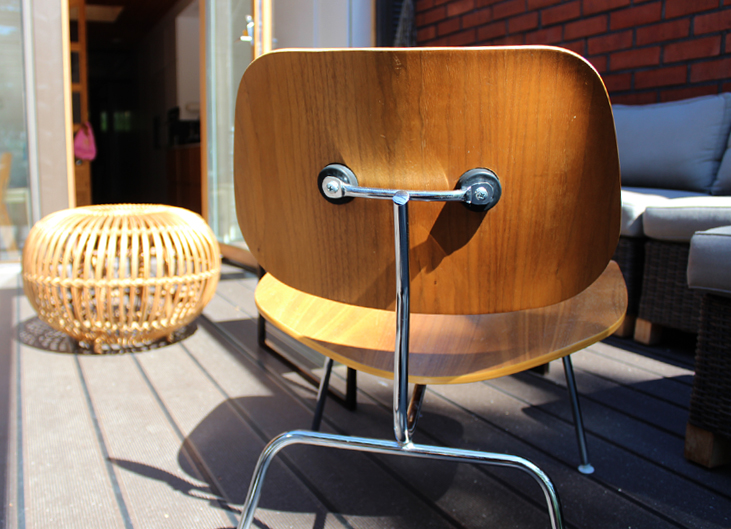
Around the table there are two LCM chairs by Charles and Ray Eames. These chairs used to reside in the living room, but being approximately the same height than the couch they turned out to be a great addition around the coffee table. Naturally, as they do not handle rain very well, they need to be brought back inside if it is raining. Fortunately they are quite light, so transport back and forth depending on the weather is not a major effort.

Overall, we are really pleased with both the style and functionality of the terrace. Being visible from most parts of the top floor we wanted to decorate it with the same style as the rest of the apartment. During the summer months, it is really like an additional room. The close location of the kitchen next to the terrace is also convenient when preparing food for barbecue. Since the arrival of the grill, it has been in active use, but being rather large and not very pretty we placed it between the couch and railing. This way it is not in anyone's way and when in use the smoke escapes away from the terrace door.

An inviting view from the kitchen

Based on the past month's experiences, we are now even more convinced the Profi Deck material was definitely the right choice for us. Both visually and practically, it compliments both the terrace and our needs. The colour is in line with the structural wood work, and the decking boards have been laid in the same direction as the overhanging wooden structure and the inside ceiling. However, even more than the visual reasons, the deck boards are laid in this direction because the floor has a slight decline towards the railing. Assembling the Profi Deck with the rubber strips creates a water proof decking allowing the rain water to flow towards the drains, which are located next to the railing. This way the deck dries faster and the water flow also helps to clean the deck from dust and other particles.

The view from the railing

One of our latest auction finds also ended up to the terrace - a rattan ottoman designed by Franco Albini for Vittorio Bonacina in 1951. Pekka has been hunting this piece (two of them, actually) for more than a year now and finally the first one found it's way to our terrace! This rattan-made piece also belongs to the permanent collection of MoMA New York. Rattan is a natural material which grows mainly in the Far East, and its characteristics include elasticity, flexibility and lightness. The stool is woven by experienced, specialised artisans, and is stunningly beautiful, practical and yes, of course, vintage!


Ottoman by Franco Albini for Vittorio Bonacina 1951

The LCM's by Eames are roughly from the same period than the Albini ottoman. The design of the LCM's actually derives from the early 1940's when Charles and Ray Eames were experimenting with wood-molding techniques. Their studies led to a commission from the US Navy requesting the Eames couple to develop plywood items used in the WWII. Later Charles and Ray applied the same technology (molding wood and glue under heat and pressure) to make affordable, high-quality veneer chairs, which could be mass-produced using dimensionally shaped surfaces.

LCM by Charles and Ray Eames for Herman Miller 1946

The plywood seat and backrest of the LCM are joined to the metal spine and legs with a series of rubber washers or "shock mounts". The shock mounts are glued under the seat and behind the backrest and screwed to the metal frame. The rubber mounts allow the backrest to flex with the person sitting in the LCM. Unfortunately, this is the greatest design flaw of the chair. The shock mounts are securely glued to the wooden backrest, but can tear free if excessive pressure is applied or when the rubber becomes brittle with age. It is not very uncommon to see vintage chairs to which holes have been drilled through the plywood to use screws to attach seat and backrest to the frame. Such a shame.

The only two companies producing LCM's chairs are Herman Miller in US and Vitra in Europe. Since the launch of LCM's they have become available in several different wood finishes and colours. Our chairs have a walnut finish and are made by Herman Miller.


LCM's with Ottoman

On a completely other topic, there have been two recent landmarks in our little daughter's life: she just celebrated her first birthday, and a bit after that, learned to walk. For her birthday present, she received a beautiful flower from her grand mother.


Flower on teak

Just like us adults, also the junior members of the family are really enjoying the sunny terrace. Also, we brought the plants out for the summer to allow them to take advantage of the short sunny summer months of the Scandinavian summer.

Two happy juniors


To conclude, it is now a bit difficult even to remember the terrace before the transformation. We just love it! To us, the Profi Deck is a perfect solution: it has a flexible design and is easy to install and maintain (even the worst barbecue messes have been easy to clean). It is also visually appealing and very pleasant to walk on. Finally, an important attribute for us was also the fact that the Profi Deck material is upcycled, and thus in line with our goal to conserve as much of the original elements of the apartment as possible and reuse recycled materials wherever feasible. Therefore, we are glad to recommend the Profi Deck solution for anyone. If you want to come and check it out, you are most welcome!

Feb 16, 2013

The Cherner Chair

Remember the problem concerning the dining room chairs we addressed in the Round of Excuses posting? Briefly, after switching to a larger, elliptical table, we noticed there is no way to fit two DAWs between the table legs. Therefore, a global hunt for new chairs was initiated and finally we are delighted to report the most recent success of the HDP model!

The chair of the choice is the Cherner chair, by Norman Cherner for Plycraft (1958). Four (out of desired six) arrived to our home about a week ago from Florida. They are vintage (naturally), beautiful and fit nicely on the sides of the table. These chairs are made of plywood walnut veneer with a vinyl naugehyde upholstery. The search still continues, however, for two armrest versions of this same chair, which will be placed on each end of the table.

Cherner chair by Norman Cherner for Plycraft (1958) 

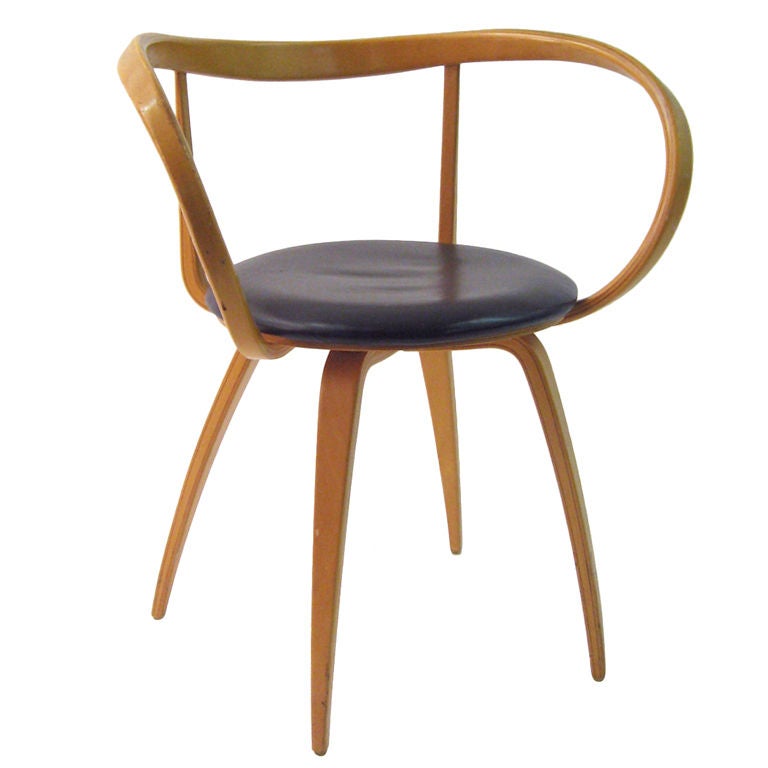
There is actually an interesting story behind the Cherner chair. In the 1950's, the Herman Miller company, led by George Nelson, wanted to create a lightweight chair out of plywood. However, the pretzel chair, designed by Nelson's office in 1952 and produced by another US company Plycraft located in Lawrence Massachusetts, was too fragile and costly, so the production was stopped in 1957.

At this point, Plycraft didn't want to waste the tooling, materials and techniques they had for constructing plywood furniture. Therefore, George Nelson recommended that Norman Cherner would design a sturdier and more economical Pretzel-like chair. Subsequently, Paul Goldman, the owner of Plycraft, hired Cherner. After turning in his design to Plycraft, however, Cherner was told the project had been stopped.

Curiously, a while later Cherner ran across his design in a furniture showroom in New York. Based on the label, he saw it was manufactured by Plycraft and designed by "Bernardo". As a result, Cherner sued Plycraft in 1961, won and received his royalties. Goldman also admitted that Bernardo was a fabricated name. Because of all this sometimes the design is mistakenly also attributed to either Paul Goldman or George Mulhauser. What a mess!!

Afterwards, Plycraft continued to produce Cherner's chair, but it was still difficult and expensive to produce. They continued to modify the original design over the years, leading to some visual variability among the vintage chairs. Ultimately, because of these difficulties the chair remained in production only until the 1970's. Cherner's sons have recently reissued their father's original designs with a company called Cherner Chair Company so a newer option exists for those who prefer new over vintage.


Label underneath our chairs indicate that they were produced after the law sued (1964)

So back to our fantastic four. After a long search we actually happened to find our chairs from Miami, USA, and they finally arrived about a week ago. Excited to see how they looked, felt and matched with the rest of the dining room, Pekka unwrapped and assembled the chairs right away.


Fresh from the Helsinki airport customs

Cherner chairs waiting to be assembled

And these four chairs are simply stunning! Someone has stated that these are the most beautiful pieces of furniture ever made out of plywood - and yes, we absolutely agree! What makes them stand out from their plywood rivals is the graduated thickness of plywood. This can be seen both on the legs and the seat. It is this structural feature that eventually enabled also the most important design cue of the Cherner chair: the narrow waist. The graduated thickness, together with the flowing shape of the armrest, were additional features making this chair difficult and expensive to manufacture. Considering all this, it is easy to see why this particular design is very difficult to copy. This is also the reason why there are so few knock-offs in the market, and if you happen to find one it would be fairly easy to distinguish a knock-off from an original.

Cherner beauty

And not only these four chairs are amazingly beautiful, they are also in exceptional condition! Manufactured in 1964 they are now nearly 50 years old and practically flawless. It is almost as if they landed to our home in a protective time capsule from a bygone era. It makes you wonder where they have spent the past 50 years - unused in some warm storage room, maybe?

Label from 1964

The foot pads, intact and like brand new. Yet, they are almost 50 years old!

At this point, we would like to present our sincerest regards to the person who sold us these beautiful chairs, Anna from Miami (dosbananos in eBay). This purchase was definitely one of the smoothest, fastest, and most reliable processes we have ever experienced. So please take note, if you are looking for a design item from the North American market. Please do not hesitate to contact her - we are glad to give her our highest recommendations!

And just to conclude - what did Urho think of all this? Honestly, he could not care less. After all, they are just chairs. Way too high for a sausage dog to enjoy them.

While you are working on those chairs, let me just rest my eyes for a minute...or two!

So the problem with the dining room chairs is now solved. Right? Well, not exactly. With the new chairs, the table no longer looks as nice as it once did...

Jan 6, 2013

Round of excuses

There are two goals for this posting. First, to introduce the last part of the living room which you have not seen yet - the dining area - and second, to discuss a major dilemma regarding the dining room chairs.

The dining area is located next to the Vodder credenza. It consists of a table for eight people, chairs and a light above the table. As you have seen in the previous postings, we also have a separate breakfast table next to the kitchen, but in addition to this we thought it would be nice to have space for group of eight diners. Easier said than done.

Looking out for snacks

The question which dining room chairs should one choose can be a tricky one. Of course, the perfect chairs do exists being a set of Kjaerholm's PK9 in cognac leather or Wegner's CH24 Wishbone chairs. However, the Kjearholm ones happen cost a small fortune thus being absolutely out of our range, and the Wishbone chair seats are woven paper cord (not a great match with small children, and they are bit of a cliche anyway). Therefore, we are forced to consider other alternatives. Up until now we have been quite happy with our current choice, the Eames plastic DAWs by Vitra. The DAW is an arm rest version of the famous Eames plastic chair, which was launched in 1948 for the Museum of the Modern Art low cost furniture design competition, being the very first industrially manufactured plastic chair. 

The DAW was originally produced by Zenith plastics in Los Angeles as a fiber glass version (the famous rope edge chair). However, due to the environmental pressures both Herman Miller and Vitra started to produce it in injection molded version, which are the ones we currently have. Originally, this chair was launched with a rod base, and the DAW base which we have in our chairs was actually used for a very short time period during the 1950's. It was brought back to manufacturing only several years later. The chair works well around the table but also equally nicely as a side chair or a study room chair.

Eames DAW

As much as we like the Eames plastic chairs, they have one fundamental problem considering our dining room. We would like to fit two chairs on each side of the table and one on each end, but unfortunately there is not enough space between the table legs on the sides for two chairs to be pushed under the table when not used. Having eight of them would be just too much, even in temporary use. Therefore, all four chairs are on sale in Huuto.net, either as single items or as a set of four. If you are interested, do not hesitate to contact as by email (theolivegreenwindow@gmail.com). 

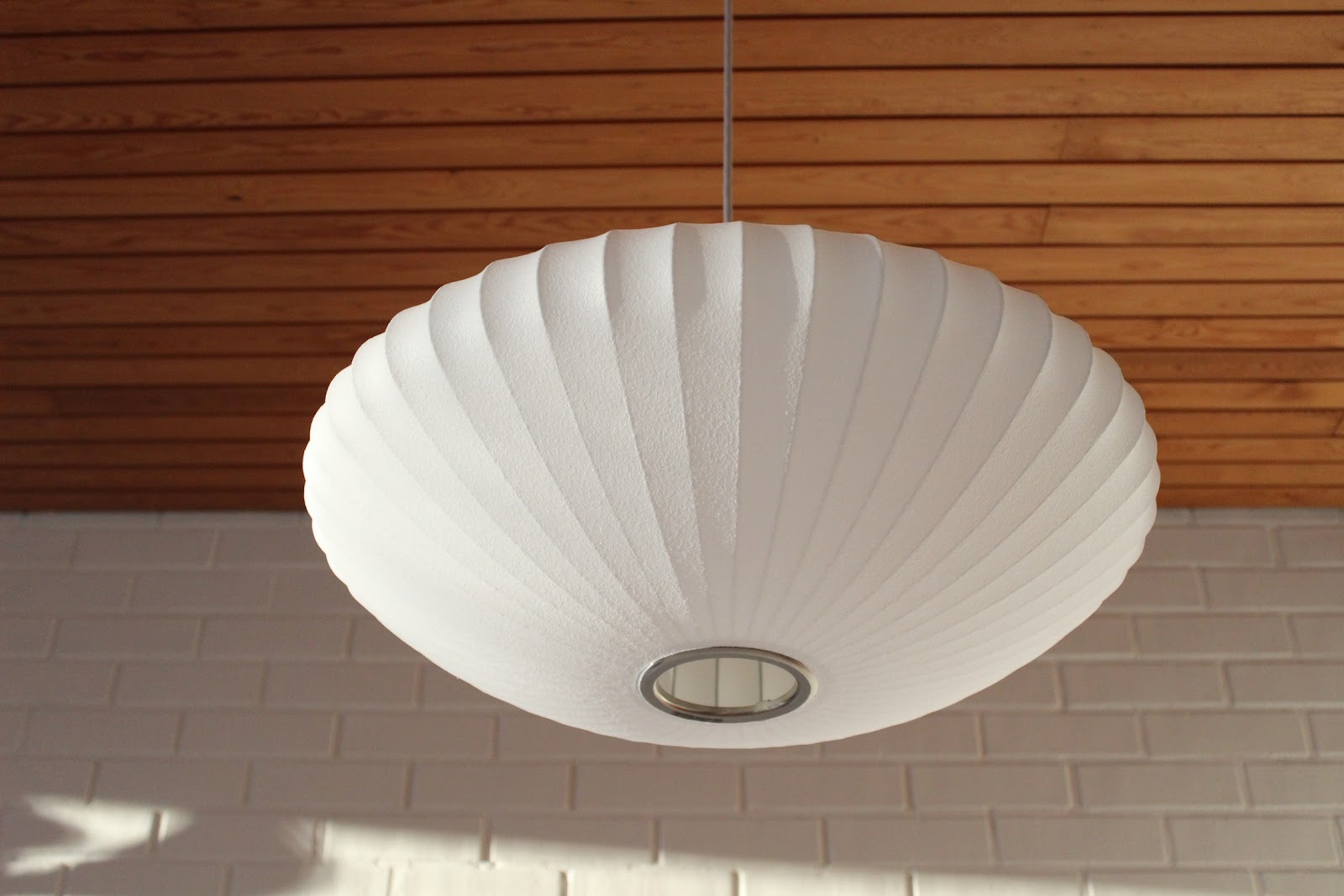
Another interesting topic is the choice of the dinner table light. Many of you know and might even have the Lokki light (also known as Lentävä Lautanen, the Flying Saucer) by Yki Nummi. Very few lights have gained such a prominent national status as the Lokki in Finland or the famous PH5 by Henningsen in Denmark. The George Nelson Bubble lamp has a very similar status in USA. It became the mid century pendant light of choice by the Average Joe. We usually prefer vintage, but in this case we chose a later production series instead, as the cover material in the older lights tends to turn ugly yellow with age.  

Nelson Bubble Light by Modernica

Those of you who visited our old apartment might remember our old ROUND dining room table. As we now have a bit more space and aim seating eight diners at the same time, we "upgraded" to a Piet Hein's Superellipse manufactured by Fritz Hansen...well, almost. When searching for a large round table to our old apartment, we came to notice they weren't widely available. Therefore, we bought a set of original legs from an auction house and ordered a custom made table top separately. Now, it was easy to change the table top to something which greatly reminds the Superellipse (Our apologizes, Piet!). We usually don't like cutting corners this way, but somehow this can be justified by significant wear and tear caused by kids. 

DIY superellipse

So if you are wondering which dining room chairs we have set our minds at after selling the Eames chairs? Well, keep on reading the blog and you will find out, as the HDP model is actively being used in chair search!